
Parent-Child Activities That Enhance Social Understanding
Social skills are the building blocks of healthy relationships, emotional well-being, and future success. As parents, we often focus on academic achievements and physical development, but nurturing our children’s ability to understand and navigate the social world is equally crucial. These skills aren’t innate; they are learned through observation, practice, and guidance. This article dives deep into practical, engaging activities parents can actively participate in with their children to bolster their social understanding, moving beyond simply telling them how to behave to actively building the foundational skills needed for positive peer interaction.
The importance of strong social understanding extends far beyond the playground. Children who struggle socially may face difficulties with emotional regulation, experience greater anxiety, and encounter challenges forming lasting friendships. These difficulties can impact their academic performance, self-esteem, and overall life satisfaction. Conversely, children with well-developed social skills are more resilient, adaptable, and better equipped to thrive in various social contexts. By intentionally investing in social-emotional learning through play and interaction, parents empower their children to build confident, healthy, and fulfilling lives.
This isn’t about creating children who are universally liked; it’s about fostering their capacity for empathy, perspective-taking, and effective communication – skills that form the bedrock of genuine connection. Essentially, it’s about helping them understand why people do what they do and how their actions impact others. This article will explore activities rooted in those principles, offering a blend of theoretical insight and practical application to help you navigate this vital aspect of parenting.
- Role-Playing: Stepping Into Another's Shoes
- Storytelling & “What If?” Discussions
- Collaborative Games: Teamwork & Negotiation
- Observing and Discussing Social Interactions (Real-Life & Media)
- Emotion Charades & Feeling Identification Activities
- Jigsaw Puzzles and Building Projects: Patience & Perspective-Taking
- Conclusion: Nurturing Social Intelligence – A Lifelong Investment
Role-Playing: Stepping Into Another's Shoes
Role-playing is a remarkably effective technique for cultivating empathy and understanding different perspectives. It allows children to practice navigating social scenarios in a safe and controlled environment, experimenting with communication styles and learning to anticipate the reactions of others. The key to successful role-playing isn't dictating solutions, but facilitating exploration and encouraging your child to think critically about the situation from multiple angles.
Start with scenarios your child frequently encounters: sharing toys with a friend, resolving a disagreement, or politely declining an invitation. Act out the scenario with your child, taking turns playing different roles. For example, if your child consistently struggles with sharing, you could play the friend who wants a turn with a toy, expressing your disappointment politely. This allows them to experience what it might feel like to be the one asking and to practice responding with empathy. Importantly, don’t immediately “fix” their responses; allow for some experimentation and awkwardness.
Beyond everyday scenarios, explore more complex situations that require nuanced social understanding. For example, role-play someone feeling left out at a party, or a character dealing with the aftermath of a misunderstanding. The goal is not perfection, but to cultivate flexible thinking and the ability to consider circumstances from viewpoints different from their own. Dr. Laura Markham, author of Peaceful Parent, Happy Kids, emphasizes the importance of validating feelings during role-play, saying, “Acknowledging a child's frustration or sadness makes them more receptive to learning alternative behaviors.”
Storytelling & “What If?” Discussions
Stories offer a powerful vehicle for exploring social dynamics and prompting discussion about characters’ motivations, feelings, and actions. Reading books together isn’t just about literacy; it’s an opportunity to actively engage with social narratives and discuss the underlying complexities. Choose stories that present diverse characters facing relatable social challenges – conflict, cooperation, kindness, and betrayal.
Instead of simply asking "Did you like the story?", delve deeper. Pause at key moments and ask "What do you think the character is feeling right now?" or "Why do you think they did that?". Extending this further, introduce "What if?" scenarios. ("What if the character had said something different?"). This encourages critical thinking and allows your child to explore alternative outcomes, strengthening their understanding of cause and effect in social interactions. Consider making up your own stories together, collaboratively building the narrative and exploring the character's emotional landscape.
This method isn’t confined to fictional stories. Reflecting on events from your child’s day – a disagreement with a sibling, a positive interaction at school – using a narrative framework ("So, you felt frustrated when he took your block tower…") can also be highly effective. This helps them process their own experiences and learn from them, transforming potentially negative events into valuable learning opportunities.
Collaborative Games: Teamwork & Negotiation
Many traditional children’s games inadvertently foster competition over cooperation. While healthy competition isn't inherently negative, consciously selecting or adapting games to emphasize collaboration is a fantastic way to build social understanding. Games requiring teamwork teach children the importance of communication, compromise, and shared responsibility. Board games that require players to work together towards a common goal, like Forbidden Island or Pandemic, provide fantastic opportunities for this.
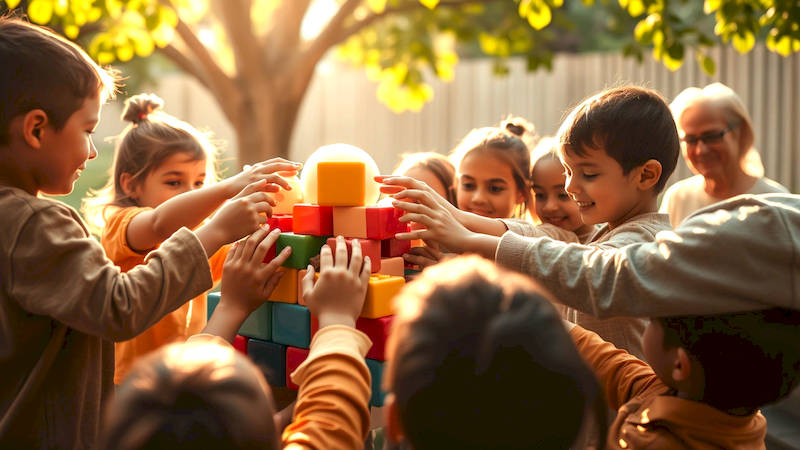
Beyond board games, even simple activities can be adapted. Instead of a race, create a collaborative building challenge: “Let’s build the tallest tower together using these blocks.” Focus on the process of collaboration, offering prompts like, “How can we make sure the tower is stable?” or “What if we tried stacking the blocks differently?”. Introduce opportunities for negotiation - perhaps dividing tasks or agreeing on a building strategy.
Furthermore, remember that losing gracefully is an important social skill. Help your child understand that losing isn't about personal failure, but simply a part of the game. Emphasize the effort they put in and the fun they had playing together, instead of dwelling on the outcome. A study by the University of Pennsylvania found that children who participate in cooperative games demonstrate higher levels of pro-social behavior.
Observing and Discussing Social Interactions (Real-Life & Media)
Children learn significantly by observing the behavior of others. Consciously point out and discuss social interactions you witness in everyday life. This could involve commenting on how someone showed kindness, how a disagreement was resolved, or how body language conveyed a particular emotion. Keep your observations neutral and avoid judgmental language. Instead of saying “That person was rude,” try “I noticed they spoke very loudly and didn’t make eye contact. What do you think might be happening?”.
This approach extends to media consumption. When watching age-appropriate television shows or movies with your child, pause and discuss the characters' interactions. "What do you think that character is feeling now?" or "Why do you think they reacted that way?”. Use these moments as opportunities to explore different perspectives and talk about the consequences of actions. However, be mindful of screen time limits and prioritize real-life interactions.
It's essential to model positive social behavior yourself. Children are constantly observing your interactions with others. Demonstrate empathy, active listening, and respectful communication in your own relationships.
Emotion Charades & Feeling Identification Activities
A crucial component of social understanding is the ability to accurately identify and label emotions, both in oneself and in others. Emotion charades is a fun and engaging way to build this skill. Write down different emotions on slips of paper (happy, sad, angry, frustrated, surprised, etc.) and have your child act them out without speaking. Encourage them to use facial expressions and body language to convey the emotion.
Supplement this with feeling identification activities. Use picture cards depicting faces expressing various emotions and ask your child to identify them. Discuss the physical sensations that often accompany different emotions – a racing heart when anxious, clenched fists when angry. Expand this beyond basic emotions to more nuanced ones like disappointment, embarrassment, or pride.
Connecting emotions to real-life experiences is vital. "Remember when you didn't get to go to the park? You looked really disappointed." This reinforces the link between feelings, situations, and appropriate responses. Acknowledging and validating your child's emotions, even the uncomfortable ones, is fundamental to their emotional development and social competence.
Jigsaw Puzzles and Building Projects: Patience & Perspective-Taking
While seemingly unrelated to social skills, activities like jigsaw puzzles and complex building projects (LEGOs, construction sets) can subtly contribute to social understanding. These activities require patience, persistence, and the ability to see a task from multiple angles – skills that translate directly to social settings. Successfully completing a complex puzzle as a team, for example, necessitates clear communication, shared decision-making, and respecting each other’s contributions.
These activities can also foster perspective-taking. If the puzzle is challenging, encourage your child to consider what another person might see or how they might approach the problem. Similarly, with building projects, encourage them to consider how their structure will appear from different viewpoints. For instance, “How will it look from your brother’s perspective?”. This develops the ability to consider the impact of their actions on others.
Importantly, avoid taking over or correcting your child’s approach. Allow them to struggle and experiment, offering guidance only when needed. The focus should be on the process of collaboration and problem-solving, not on achieving a perfectly completed product.
Conclusion: Nurturing Social Intelligence – A Lifelong Investment
Enhancing a child’s social understanding is not a one-time fix but an ongoing process requiring consistent effort and intentional engagement. By incorporating activities like role-playing, storytelling, collaborative games, and emotion-focused exercises into your daily routine, you are actively equipping your child with the essential skills they need to navigate the complexities of human interaction. Remember, the goal isn't to mold a perfectly compliant child, but to foster empathy, perspective-taking, and effective communication.
The key takeaways from this exploration are the importance of actively facilitating social learning rather than solely instructing and the power of using everyday situations as learning opportunities. Prioritize creating a safe and supportive environment where your child feels comfortable exploring emotions, expressing their thoughts, and experimenting with different social strategies. Invest in these skills, and you are investing in a future where your child will not only thrive personally but will also contribute to a more compassionate and understanding world. Start with one or two activities today, and observe the positive shift in your child’s social confidence and interactions – a testament to the power of connection and dedicated parenting.
Deja una respuesta