
Step-by-Step Guide to Teaching Kids Basic Engineering Concepts Through Block Building
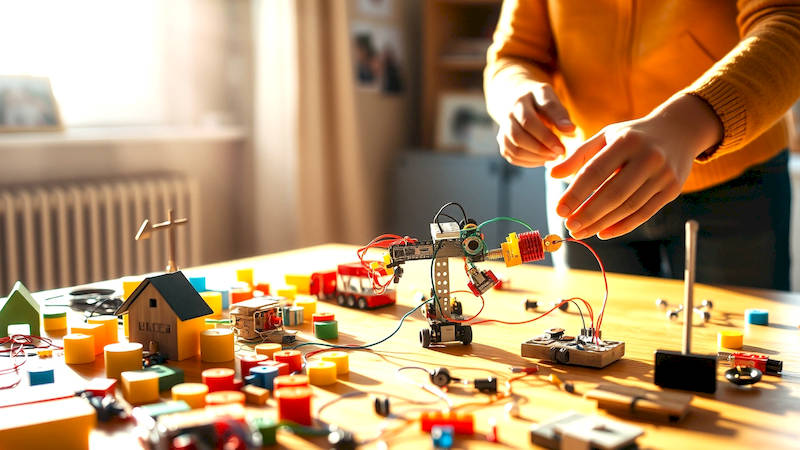
For generations, blocks have been a staple in children’s playrooms, often seen simply as colorful toys fostering creativity. However, blocks are far more than just fun; they are powerful tools for introducing fundamental engineering concepts in an accessible and engaging way. In a world increasingly driven by STEM (Science, Technology, Engineering, and Mathematics), equipping children with these foundational skills early is paramount. This isn’t about turning toddlers into civil engineers, but about nurturing problem-solving abilities, spatial reasoning, and a design-thinking mindset.
The benefits of early STEM exposure are well-documented. Studies show children who engage in STEM activities from a young age develop stronger critical thinking skills, a deeper understanding of the world around them, and are more likely to pursue STEM-related fields later in life. Block building taps into this inherent curiosity, allowing children to experiment, iterate, and learn through playful exploration. What’s more, it’s a low-pressure, low-cost way to lay the groundwork for future academic success.
This article will serve as a comprehensive guide for parents and educators, offering a step-by-step approach to leverage block building to teach basic engineering concepts to children. We'll move beyond simply stacking blocks to explore how to introduce concepts like structural stability, load-bearing capacity, design constraints, and the engineering design process, turning playtime into invaluable learning opportunities.
- Understanding the Engineering Principles Embedded in Play
- Initiating the Engineering Design Process with Blocks
- Introducing Design Constraints and Problem-Solving
- Exploring Different Block Types & Their Engineering Applications
- From Towers to Towns: Scaling Up Complexity
- Encouraging Documentation & Reflection of the Process
- Conclusion: Building a Foundation for Future Success
Understanding the Engineering Principles Embedded in Play
At its core, engineering is about problem-solving—identifying a need and devising a solution. Block building naturally lends itself to this process. The 'need' might be as simple as 'build the tallest tower,' or 'create a house for this animal figure.' The solution requires children to think strategically about how to combine materials, distribute weight, and overcome challenges. Crucially, failures are part of the learning process; a collapsing tower isn't a disappointment but an opportunity to analyze what went wrong and try a different approach.
One foundational engineering principle demonstrated through block play is structural integrity. Children quickly learn that certain shapes and arrangements are more stable than others. A wide base provides more support than a narrow one, and interlocking blocks create stronger connections. Encourage observation by asking questions like, “What happens when you stack the blocks really high? Why does it fall over?” This prompts children to think about weight distribution and balance, key concepts in structural engineering. According to a report by the National Research Council, “Early childhood experiences with building and construction play are directly related to later success in spatial reasoning and mathematics.”
Beyond stability, block building implicitly teaches about load-bearing capacity. Different materials (wooden blocks versus cardboard blocks, for example) have different strengths. Children will intuitively discover this as they build, learning that certain structures can support more weight than others. This is a natural introduction to the concept of material properties and their influence on design. Encouraging children to test their creations—by gently adding small objects to their structures—reinforces this idea.
Initiating the Engineering Design Process with Blocks
The engineering design process isn't solely for professional engineers; it's a systematic way of solving problems applicable to any situation, even block building. This process typically involves identifying a problem, brainstorming solutions, designing, creating, testing, and evaluating. With young children, you can simplify this process into five steps: Ask, Imagine, Plan, Create, and Improve.
Start by posing a challenge – "Can you build a tower that’s taller than you are?” (Ask). Then, encourage your child to brainstorm ideas – “What kind of blocks will you use? How will you make it strong?” (Imagine). Next, guide them to create a simple plan, perhaps through a rough sketch or verbal description (Plan). The actual building process is the ‘Create’ stage. Finally, and perhaps most importantly, encourage evaluation: "What worked well? What didn’t work? How could you make it better next time?” (Improve). This final step cultivates a growth mindset and teaches children to learn from their mistakes.
Remember that the goal isn’t a perfect structure; it’s the process of thinking like an engineer. Documenting the process – through photos or simple drawings – can also be valuable. This allows children to reflect on their work and track their progress over time. It’s a fantastic way to illustrate iterative design – the idea that design isn't a one-time event but a cycle of improvement.
Introducing Design Constraints and Problem-Solving
Engineering isn’t just about limitless creativity; it's about finding solutions within limitations. These limitations are known as design constraints. Introducing constraints to block building challenges forces children to think more strategically. Constraints can be related to materials (e.g., “You can only use red and blue blocks”), time (e.g., “You have 10 minutes to build a bridge”), or functionality (e.g., “The bridge must be able to hold a toy car”).
For example, present a challenge: "Build a house for this stuffed animal, but you can only use rectangular blocks." This constraint forces the child to problem-solve—how can they create a sloped roof or curved walls using only rectangular blocks? This fosters creative thinking and resourcefulness. Another option is to introduce a weight constraint: "Build a tower that can support at least three small toys." This encourages them to consider structural stability and load distribution.
By adding constraints, you’re mirroring the real-world challenges faced by engineers, who must always work within budgets, material limitations, and safety regulations. It’s a valuable lesson in practical problem-solving and the importance of adaptability.
Exploring Different Block Types & Their Engineering Applications
Not all blocks are created equal. Different block types lend themselves to exploring different engineering concepts. Traditional wooden blocks, with their uniform shapes, are excellent for introducing concepts of balance and stability. Interlocking bricks, like LEGOs, allow for more complex and precise structures, opening the door to exploring concepts like gear ratios and simple machines.
Magnetic tiles facilitate exploration of geometry and spatial reasoning. The magnetic forces allow for easy connections, making it simpler to create 3D structures. However, they also present unique challenges related to magnetic attraction and repulsion, providing opportunities for experimentation. Even unconventional materials, like cardboard boxes and recycled materials, can be incorporated into block play, fostering creativity and introducing the concept of sustainable engineering.
Consider a project where you challenge your child to build a ramp using various block types. What works best for creating a smooth, stable slope? How does the angle of the ramp affect the speed of an object rolling down it? Through experimentation, they'll learn about friction, gravity, and the principles of inclined planes.
From Towers to Towns: Scaling Up Complexity
As your child's understanding grows, you can gradually increase the complexity of the challenges. Start with simple tasks, like building the tallest tower or the longest bridge, and progress to more complex projects, like designing a city with specific features (roads, buildings, parks). Encourage collaborative building, where children work together to solve a problem. This promotes communication, teamwork, and negotiation skills.
Introduce specific design briefs: "Design a house that protects its inhabitants from the rain," or "Build a structure that can withstand a simulated earthquake (gentle shaking)." These briefs require children to consider multiple factors and integrate different engineering principles. An important aspect is to encourage planning; have them draw a basic blueprint before they start building.
Moreover, leverage storytelling to enhance engagement. "The town needs a new hospital. Can you design and build one?" Combining narrative with engineering challenges makes the learning process more immersive and meaningful.
Encouraging Documentation & Reflection of the Process
Learning isn’t just about the finished product; it’s about documenting the journey. Encourage children to record their work through drawings, photos, or even short videos. Ask them to describe their design process: "What were you trying to achieve? What challenges did you face? How did you overcome them?"
Creating a “design journal” – a simple notebook where they can sketch ideas, record observations, and document their building projects – is a great way to foster reflection. Question prompts can be helpful: "What did you learn from this project? What would you do differently next time?" Sharing their work with others—family members, classmates—provides an opportunity to receive feedback and articulate their ideas.
This documentation process isn't just about assessment; it’s about instilling a sense of ownership and pride in their creations. It reinforces the idea that the process of engineering is as important as the outcome.
Conclusion: Building a Foundation for Future Success
Through seemingly simple block play, we can unlock a child’s potential for engineering thinking. This guide has outlined a step-by-step approach to move beyond freeform building and intentionally integrate core engineering concepts. Remember to emphasize the importance of the design process, embrace constraints as learning opportunities, and leverage different block types to explore a wide range of principles.
The key takeaway isn’t about creating future engineers, but fostering a mindset of problem-solving, critical thinking and innovation. Encouraging your child to ask questions, experiment fearlessly, and learn from their mistakes will equip them with invaluable skills that will benefit them throughout their lives. Continue to provide open-ended challenges, offer support when needed, and most importantly, celebrate their efforts. Embrace block building as a playful and powerful tool for nurturing the next generation of thinkers, builders, and innovators.
Deja una respuesta