
How to Use Legos to Teach Basic Mechanical Engineering and Design Principles
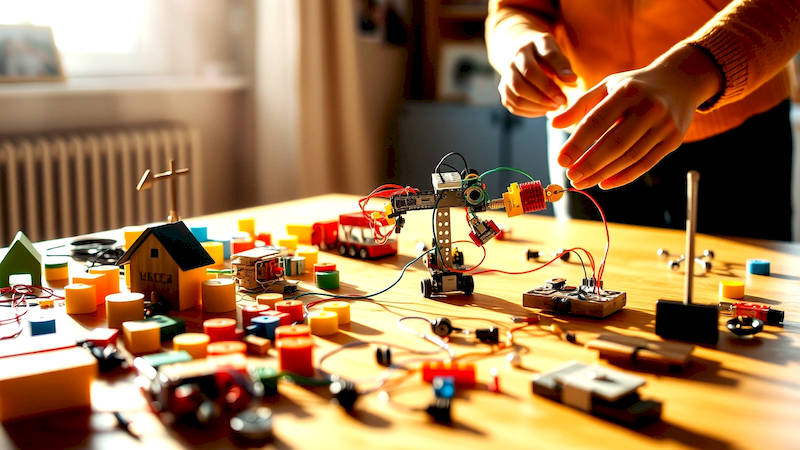
The world is rapidly evolving, driven by advancements in science, technology, engineering, and mathematics (STEM). Cultivating an early interest in these fields is crucial for preparing children for the jobs of tomorrow. But STEM education doesn’t have to be confined to textbooks and classrooms. In fact, one of the most engaging and effective tools for introducing these concepts is already likely residing in many homes: Lego bricks. Beyond being a beloved toy, Legos offer a hands-on, playful environment for children to explore fundamental principles of mechanical engineering, structural design, and problem-solving.
This article will delve into the remarkable potential of Lego bricks as a STEM learning tool, moving beyond simple building to demonstrate how to impart core engineering concepts. We'll explore how to use Legos to teach everything from simple machines and structural integrity to gear ratios and basic robotics—all while fostering creativity and a love for learning. The goal isn’t necessarily to create future professional engineers, but to build critical thinking skills and a foundational understanding of how things work, preparing children to be innovative problem-solvers in any field they choose.
Understanding Simple Machines with Lego Bricks
Simple machines are the building blocks of all more complex machinery. Understanding these basic principles – leverage, pulleys, inclined planes, wedges, screws, and wheels & axles – is fundamental to understanding how things move and work. Legos provide a fantastic medium for physically demonstrating these concepts in a safe and engaging way. For example, building a simple Lego lever with a fulcrum (another Lego brick) allows children to experiment with how the position of the fulcrum affects the force needed to lift an object.
To illustrate, challenge your child to build a Lego crane. This project inherently incorporates a lever (the lifting arm), a wheel and axle (the winding mechanism), and requires an understanding of load distribution. Start with very basic instructions and then encourage experimentations – "What happens if we move the fulcrum closer to the load?" or "Can we make the lifting arm longer to lift heavier objects?". This exploration reinforces the relationship between force, distance, and work, offering invaluable tangible learning.
The beauty of Legos is the iterative process. Children can easily modify their designs – a core principle in engineering – and observe the consequences of their changes. This fosters a deeper comprehension of how simple machines function and interact. Don’t shy away from introducing the terms themselves alongside the practical activities; the concrete experience will solidify their understanding.
Exploring Structural Integrity and Stability
Engineering isn’t just about making things move; it’s also about making things stand. Teaching children about structural integrity – the ability of a structure to withstand stress – using Legos is a powerful lesson in design and planning. Simply asking a child to build the tallest tower they can often reveals an immediate need for structural principles. Initial attempts will likely result in wobbly, collapsing towers, which provides an excellent opportunity to discuss how to improve stability.
Talk about concepts like base width and shape. A wide base will generally offer more stability. Introduce different building techniques, such as interlocking bricks in alternating directions to distribute weight more evenly. Challenge them to build structures that can withstand a “shake test” – gently shaking the table or surface the structure is built on. Encourage experimentation with different shapes – triangles are inherently strong and resistant to deformation.
Consider a case study: The Tacoma Narrows Bridge collapse in 1940 is a prime example of a structural failure. While explaining this complex event to a child might be challenging, you can draw parallels to their Lego towers – if a structure isn't properly supported or designed to withstand forces, it will fail. This illustrates the importance of careful planning and design.
Gear Ratios and Mechanical Advantage
Gears are a core component of many mechanical systems, and Legos, with their readily available gear components, are perfect for demonstrating how they work. Introducing the concept of gear ratios – the relationship between the number of teeth on two gears – is a surprisingly accessible activity. Begin by building a simple system with two gears of different sizes and observing how turning one gear affects the speed and torque of the other.
Explain that a larger gear driving a smaller gear increases torque (rotational force) but reduces speed, while the opposite is true when a smaller gear drives a larger gear. This is the fundamental principle behind mechanical advantage, allowing us to accomplish tasks that would otherwise require more force. Challenge your child to create a Lego vehicle with different gear ratios to experiment with speed versus climbing ability.
This practice ties directly into real-world applications. Cars use gear ratios to balance speed and power. A lower gear provides more torque for accelerating or climbing hills, while a higher gear allows for efficient cruising at higher speeds. By using Legos, the abstract concept of gear ratios becomes tangible and understandable. A quote from famed engineer Henry Petroski resonates here: "Engineering is essentially failure recovery." – encouraging children to experiment and adjust their designs when things don't work initially.
The Importance of Design and Iteration
Engineering is rarely a linear process. It involves design, prototyping, testing, and refining. Legos excel at facilitating this iterative design cycle. Encourage your child to first sketch out their ideas before building, even if it’s just a rough diagram. This fosters the habit of planning and visualization, crucial skills for any engineer.
Then, the building phase allows them to bring their ideas to life. But the real learning happens during testing and evaluation. Does the structure stand? Does the machine work as intended? If not, why not? This is where problem-solving skills come into play. "What can we change to make it stronger? Faster? More efficient?". The ability to identify problems, brainstorm solutions, and implement changes is at the heart of the engineering process.
Present challenges that require several iterations. For instance, task your child with building a Lego device to transport a small object from one point to another. The initial design will likely be flawed. This prompts the child to rethink their approach, experiment with different mechanisms, and continuously refine their design until it meets the desired objective. The more they go through this cycle, the better they become at identifying potential problems before they build and finding creative solutions.
Introducing Basic Robotics with Lego WeDo or Mindstorms
While standard Lego bricks are excellent for introducing mechanical principles, expanding into Lego WeDo or Mindstorms brings a new level of complexity and excitement. These kits include programmable bricks, sensors, and motors, allowing children to build and program robots. This opens up a world of possibilities for learning about robotics, coding, and automation.
WeDo is an excellent starting point for younger children, offering a visual programming language that’s easy to learn. Building a simple robot that responds to sensors – like a light sensor or a tilt sensor – introduces the concept of feedback loops and control systems. Mindstorms, geared towards older children and teens, offers a more sophisticated programming environment and allows for the creation of more complex robots with advanced capabilities.
Building and programming a Lego robot to navigate a maze, sort objects, or perform a specific task requires the application of all the principles discussed earlier – structural integrity, simple machines, and gear ratios – in a real-world context. It’s a hugely rewarding experience that fosters creativity, problem-solving skills, and a passion for STEM.
Beyond the Bricks: Cultivating an Engineering Mindset
The power of using Legos for STEM education extends beyond the construction process itself. The key is to nurture a specific mindset – a curiosity about how things work, a willingness to experiment and fail, and a persistence in finding solutions. This involves asking open-ended questions ("What if we tried…?") rather than providing direct answers. It means encouraging exploration and celebrating the learning process, even when things don't go according to plan.
Remember, the goal isn’t to turn every child into an engineer, but to equip them with the critical thinking and problem-solving skills that will serve them well in any field. By providing a playful, hands-on environment for exploration, Legos can ignite a passion for STEM and empower children to become confident, creative, and innovative thinkers.
In conclusion, Legos are far more than just a colorful collection of plastic bricks. They are a powerful educational tool that can introduce children to fundamental principles of mechanical engineering, structural design, and robotics in an engaging and accessible way. By incorporating simple machines, exploring structural integrity, understanding gear ratios, and embracing the iterative design process, parents and educators can help children develop the skills and mindset needed to thrive in the 21st century. The key takeaways are to foster experimentation, encourage problem-solving, and celebrate the journey of learning. Start with simple challenges, gradually increase complexity, and most importantly, have fun! Encourage your child to build, explore, and discover the amazing world of engineering, one Lego brick at a time.
Deja una respuesta