
Teaching Problem-Solving Through Simple Puzzles and Games for Preschoolers
The ability to solve problems is a cornerstone of success, not just in academics, but in life. Yet, problem-solving isn't an innate talent; it’s a skill that is meticulously built and honed over time. And remarkably, the foundation for strong problem-solving skills is laid during the preschool years. Far from complex calculations or intricate strategies, fostering this vital ability starts with simple, playful interactions. This article will delve into the powerful connection between puzzles, games, and the cognitive development of preschoolers, exploring how parents and educators can strategically utilize these tools to cultivate critical thinking and a lifelong love of learning.
Early childhood is a period of immense neurological growth. The brain is incredibly plastic, meaning it’s readily shaped by experiences. Experts in early childhood development, such as Dr. Maria Montessori, have long emphasized the importance of “self-correction” and “materials for exploration” in fostering independent thinking. By providing preschoolers with opportunities to encounter and overcome challenges through play, we aren't just keeping them entertained; we’re actively wiring their brains for resilience, analytical thought, and creative solutions. Ignoring this foundational period means potentially hindering a child’s future capacity for innovation and adaptability.
- Why Problem-Solving Skills Matter in Preschool
- Selecting the Right Puzzles and Games: Age-Appropriateness is Key
- The Power of Scaffolding: Guiding, Not Giving Answers
- Turning Everyday Routines into Problem-Solving Opportunities
- The Importance of Open-Ended Play and Exploration
- Observing and Adapting: Meeting Your Child’s Individual Needs
Why Problem-Solving Skills Matter in Preschool
Traditionally, preschool education has heavily focused on foundational literacy and numeracy. While these skills remain vital, an increasing body of research highlights the equal (and sometimes greater) importance of “executive function” skills - a suite of cognitive processes that include working memory, cognitive flexibility, and – crucially – problem-solving. These skills are strong predictors of academic success, social-emotional wellbeing, and even long-term career outcomes. Children with strong problem-solving abilities demonstrate greater persistence when faced with obstacles, are less likely to become frustrated, and are better equipped to regulate their emotions in challenging situations.
Developing these skills in the preschool years isn’t about turning children into miniature mathematicians or scientists. It's about nurturing their natural curiosity and providing safe, supportive environments where they feel comfortable experimenting, making mistakes, and learning from them. A study published in the journal Child Development found that preschool children who regularly engaged in puzzle-solving activities showed significant gains in spatial reasoning and cognitive flexibility, skills directly linked to mathematical and scientific aptitude. Simply put, problem-solving isn’t just about finding answers, it’s about learning how to find answers.
Furthermore, problem-solving skills translate directly into enhanced social skills. Learning to navigate a challenging puzzle alongside a peer, for instance, encourages collaboration, communication, and negotiation - all essential components of healthy social interaction. This collaborative problem-solving fosters empathy and teaches children to appreciate diverse perspectives, laying the groundwork for strong, positive relationships.
Selecting the Right Puzzles and Games: Age-Appropriateness is Key
Choosing appropriate puzzles and games is paramount for effective learning. What might be stimulating for a four-year-old could be profoundly frustrating (and ultimately discouraging) for a three-year-old. Generally, start with puzzles that have very few pieces – think four to six – and large, easily manipulable components. Wooden peg puzzles, shape sorters, and simple jigsaw puzzles with bold, clear images are excellent starting points. Remember, the goal isn't necessarily completion, but the process of exploration and experimentation.
Gradually increase complexity as the child demonstrates mastery. As they progress, introduce puzzles with more pieces, puzzles that require more spatial reasoning (like pattern block puzzles), and games that involve simple rules and strategic thinking. Consider games like "Candy Land," which introduce turn-taking and basic rule following, or matching games which enhance memory and visual discrimination skills. Avoid puzzles or games with excessively rigid solutions or highly competitive elements, especially in the early stages. The focus should be on fostering intrinsic motivation and a positive attitude towards challenges, rather than achieving "winning."
Finally, observe your child’s approach. Does your child approach puzzles systematically, or through trial and error? Use your observations to guide your selections, providing challenges that stretch their abilities without overwhelming them.
The Power of Scaffolding: Guiding, Not Giving Answers
One of the most crucial elements of fostering problem-solving skills is knowing how to support a child without simply giving them the answer. This is where "scaffolding" comes into play. Scaffolding, in educational terms, means providing temporary support that is gradually withdrawn as the child becomes more competent. Instead of saying "Put the blue piece here," try asking guiding questions like “What shape is this piece?” or “Where do you think this piece might fit based on its color?”
Resist the urge to jump in and fix things immediately. Allow your child time to struggle, to explore different possibilities, and to learn from their mistakes. Moments of frustration are valuable learning opportunities; they teach perseverance and resilience. Acknowledge their frustration ("I see you're getting a little frustrated, that's okay, puzzles can be tricky!") and offer encouragement ("You're really trying hard, keep going!") Without providing direct answers, you can offer subtle cues, like rotating a piece or pointing out a shared characteristic between the piece and the empty space. Remember, the objective is to empower them to discover the solution independently.
Furthermore, narrate their process. As they attempt to solve a puzzle, verbalize their thinking. For example, “You’re trying to fit the square into the round hole – I notice those shapes are different. What happens when you try to fit different shapes together?" This not only reinforces their thinking but also models metacognition – the ability to think about one's own thought processes.
Turning Everyday Routines into Problem-Solving Opportunities
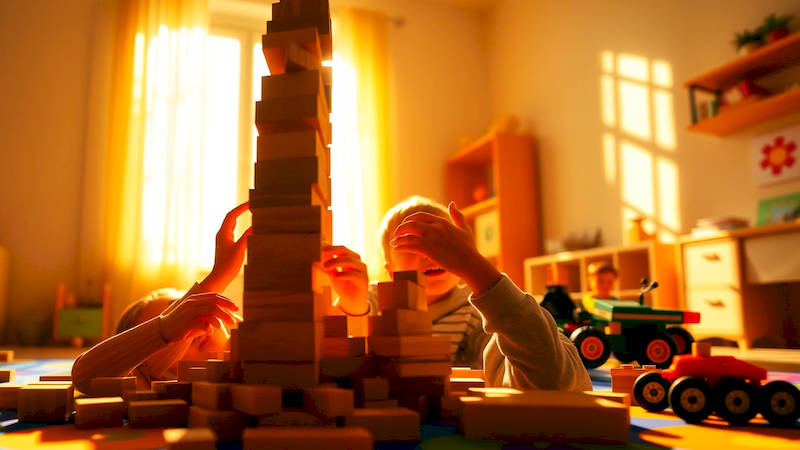
Problem-solving isn’t confined to designated “puzzle time.” Everyday routines are brimming with opportunities to encourage critical thinking. For instance, when building with blocks, ask questions like, "How can we make this tower taller without it falling over?" or "What if we used different shapes for the base?" Bedtime routines can also be transformed into problem-solving exercises. If a favorite stuffed animal is missing, instead of immediately locating it for your child, say, “Hmm, where could Teddy be? Let’s think about the last place we saw him.”
Mealtime can also be an exercise in logical thinking. “We have carrots and broccoli. We need to choose one vegetable to eat with dinner. Which one will give us the most energy?" Even simple activities like getting dressed can present challenges. “Your shoes are on the wrong feet. How can we fix that?" This approach seamlessly integrates problem-solving into the flow of daily life, making it a natural and organic part of your child’s learning experience.
The Importance of Open-Ended Play and Exploration
While structured puzzles and games are valuable, don't underestimate the power of unstructured, open-ended play. Activities like building with loose parts (buttons, bottle caps, pebbles) or creating artwork with various materials encourage children to explore possibilities, experiment with different solutions, and develop their own unique approaches. There are no "right" or "wrong" answers in open-ended play; the emphasis is on process, creativity, and imagination.
Consider setting up a "tinker tray" – a small, contained space filled with interesting materials that children can manipulate and explore. This could include items like pipe cleaners, pom-poms, wooden blocks, and small toys. Observe how your child uses these materials and resist the temptation to direct their play. Allow them to take the lead and create their own games and challenges. This type of free exploration fosters divergent thinking – the ability to generate multiple ideas and solutions – a crucial skill for innovation and problem-solving.
Observing and Adapting: Meeting Your Child’s Individual Needs
Every child learns at their own pace and in their own way. The key to successfully fostering problem-solving skills is to be observant and adaptable. Pay attention to your child’s strengths, challenges, and learning style. If they struggle with spatial reasoning, focus on activities that strengthen this skill. If they become easily frustrated, provide more support and encouragement.
Don't be afraid to modify activities or create your own challenges tailored to your child’s interests. A child fascinated by animals, for example, might enjoy a puzzle that involves matching animal tracks or creating a habitat for their toy animals. Remember, the goal is to engage their natural curiosity and motivate them to think critically. Regularly reflect upon your approach. Are you providing enough challenge without being overwhelming? Are you giving your child enough autonomy to explore and discover on their own? Adjust your strategies as needed to ensure your child is consistently learning and growing.
In conclusion, teaching problem-solving skills to preschoolers isn’t about rigorous drills or complex concepts. It’s about embracing playfulness, creating supportive environments, and providing opportunities for exploration and experimentation. By strategically using simple puzzles and games, scaffolding learning, integrating problem-solving into daily routines, and fostering open-ended play, we can empower young children to become confident, resilient, and critical thinkers. The investments made in nurturing these skills during the preschool years will yield tremendous dividends throughout their lives, equipping them to navigate the complexities of the world with intelligence, creativity, and unwavering determination. Remember to focus on the process, celebrate effort, and embrace the magic of learning through play.
Deja una respuesta