Fun Math Games That Boost Logical Thinking in Young Learners
- Introduction
- Building Blocks of Logic: Early Number Sense Games (Preschool - Kindergarten)
- Spatial Reasoning and Geometry with Tangrams & Puzzles (Kindergarten - 2nd Grade)
- Logic Grid Puzzles: Deduction and Critical Thinking (2nd - 4th Grade)
- Math Card Games: Strategy and Number Operations (3rd - 5th Grade)
- Conclusion: Cultivating a Logical Mindset
Introduction
In today's rapidly evolving world, equipping children with strong analytical and problem-solving skills is more crucial than ever. While core math skills are essential, developing logical thinking – the ability to reason, analyze, and draw conclusions – is equally vital for success, not just in academics, but in life. Unfortunately, traditional math education often focuses heavily on rote memorization and procedural fluency, sometimes at the expense of fostering genuine understanding and logical reasoning. This is where incorporating playful learning through math games becomes incredibly valuable. These games provide a non-threatening environment for children to explore mathematical concepts, experiment with strategies, and develop the critical thinking abilities needed to thrive in a complex world.
The benefits extend far beyond improved test scores. Games engage different parts of the brain, making learning more enjoyable and memorable. They encourage children to think creatively, to learn from their mistakes, and to persevere through challenges. Research consistently demonstrates a strong correlation between early exposure to STEM (Science, Technology, Engineering, and Mathematics) activities and future success in these fields. A study by the National Science Foundation found that children who participate in engaging STEM activities are more likely to pursue STEM careers. But STEM doesn’t have to be complex; the foundation starts with accessible, fun, and logic-building math activities.
This article will explore a variety of fun math games designed to boost logical thinking in young learners. We will delve into the underlying principles of each game, how they encourage specific logical thinking skills, and provide practical examples for implementation at home and in the classroom. We'll focus on games suitable for a range of ages and skill levels, from pre-schoolers to early elementary students, emphasizing play-based learning rather than formal instruction. Ultimately, the goal is to demonstrate how playful engagement with math can cultivate a love of learning and empower children with essential, lifelong logical thinking skills.
Building Blocks of Logic: Early Number Sense Games (Preschool - Kindergarten)
The foundational stage of logical thinking in math begins with developing a strong number sense. This isn't just about memorizing numbers; it's about understanding quantity, relationships between numbers, and how numbers connect to the real world. Games at this age should focus on subitizing (instantly recognizing quantity without counting), comparing numbers, and basic pattern recognition. A simple game like "Count the Collection" is excellent for subitizing. Gather a collection of small objects (buttons, blocks, toys) and challenge your child to quickly state how many there are, without counting them individually. Vary the arrangement to encourage different strategies—linear, array, and scattered—to help them see the same quantity in different formations.
Another powerful game is “More or Less.” Using a set of manipulatives, present two groups of objects and ask, "Which group has more? Which group has less?" Start with visually distinct differences and gradually decrease the gap to challenge their perceptual skills. This isn't just about recognizing ‘bigger’ or ‘smaller’; it's about understanding the underlying concept of quantity and comparison. It links abstract number concepts to concrete, physical representations. For example, you could ask, “If I add one more to this group, will it have more or less than the other?” This begins to introduce the basics of addition and subtraction in a logical, intuitive way.
Finally, pattern games are fundamental to developing logical thinking. Using colorful beads, blocks, or even drawings, create simple patterns (e.g., red, blue, red, blue) and ask your child to continue the sequence. This encourages them to analyze the repeating elements, identify the core rule, and predict the next step. Don't just stick to single-element patterns; introduce growing patterns (e.g., 1, 2, 3,…) to challenge them further. The key is to focus on the reasoning behind identifying the pattern, not just memorizing the sequence.
Spatial Reasoning and Geometry with Tangrams & Puzzles (Kindergarten - 2nd Grade)
Spatial reasoning – the ability to visualize and manipulate objects in space – is a crucial component of logical thinking, particularly in areas like geometry and engineering. Tangrams, those ancient Chinese dissection puzzles, offer a fantastic way to develop this skill. A standard Tangram set consists of seven flat shapes, which can be arranged to form various images. Presenting children with a picture and challenging them to recreate it using the Tangram pieces exercises their spatial visualization skills and problem-solving abilities. Start with simpler shapes and gradually increase the complexity.
Beyond Tangrams, jigsaw puzzles are another excellent option. They require children to analyze shapes, identify how they fit together, and develop a mental image of the final product. Consider starting with large-piece puzzles and gradually reducing the size and increasing the number of pieces as their skills improve. Look for puzzles that feature geometric shapes or scenes containing mathematical concepts (e.g., a puzzle depicting a building with different shapes). This incorporates spatial reasoning with visual mathematical learning. What's wonderful about puzzles is the built-in feedback loop: they know immediately if a piece doesn’t fit, encouraging adaptation and persistence.
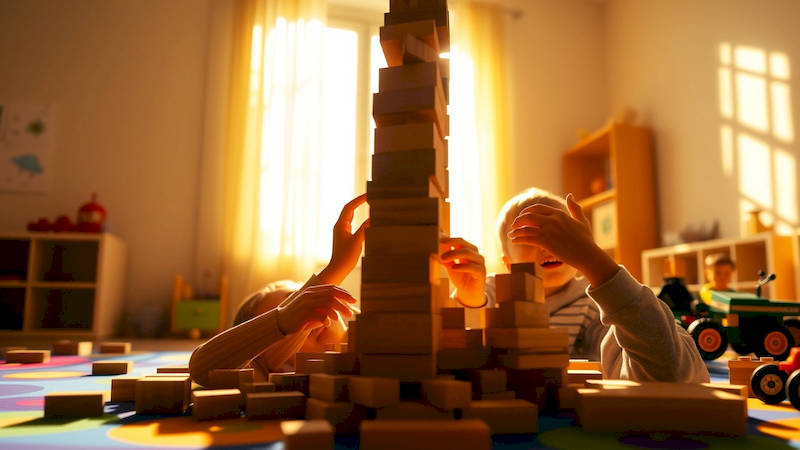
To further enhance spatial reasoning, introduce building blocks (like LEGOs or wooden blocks) and encourage free-form construction. Provide open-ended prompts, such as “Build a tower,” or “Build a house,” and let their imagination run wild. This fosters creativity and problem-solving as they figure out how to create stable structures. Challenge them to build specific shapes or patterns, reinforcing geometric concepts in a hands-on way. Encourage describing their constructions, using spatial language like "above," "below," "next to," and "around."
Logic Grid Puzzles: Deduction and Critical Thinking (2nd - 4th Grade)
As children progress, introduce games that explicitly require deductive reasoning. Logic grid puzzles are perfect for this. These puzzles present a series of clues about different categories (e.g., color, shape, animal) and require children to use logic to determine the correct matches. Start with simpler grids with fewer variables and gradually increase the complexity. For example, a grid might present clues like "The red car belongs to John" and "Mary owns the blue car." The child must deduce who owns which car based on the given information.
To facilitate understanding, work through the first few puzzles together with your child. Model the process of eliminating possibilities and explaining your reasoning. Introduce a system for marking the grid – using Xs to indicate impossibilities and circles to indicate certainties. Encourage them to explain their thinking process aloud. This helps them solidify their understanding and identify any logical fallacies. Emphasize that the goal isn’t necessarily about speed, but about systematically analyzing the information and drawing correct conclusions.
Variations on logic grids can be created using everyday scenarios. "Who ate the cookie?" is a classic example. Present clues like "The person who ate the cookie was wearing blue shoes" and "Sarah was wearing red shoes." The child must deduce who committed the cookie crime. This contextualization makes the game more engaging and relatable while still demanding logical thinking. The success with these puzzles builds confidence in their ability to handle complex information.
Math Card Games: Strategy and Number Operations (3rd - 5th Grade)
Traditional card games can be easily adapted to reinforce mathematical concepts and logical thinking. War, for instance, can be modified to focus on addition, subtraction, or multiplication. Instead of the higher card winning, players add (or subtract, or multiply) the values of their cards, and the highest sum (or difference, or product) wins. This combines the familiar fun of the game with the practice of arithmetic operations. It also encourages quick mental math skills.
Another excellent option is "24." Using a standard deck of cards (remove face cards), players must use four cards to arrive at the number 24 through any combination of addition, subtraction, multiplication, and division. This demands strategic thinking, number fluency, and problem-solving skills. Start with simpler goals (e.g., aiming for 10) to build confidence before tackling the full "24" challenge. Discuss different strategies and approaches, emphasizing that there may be multiple solutions.
Furthermore, create a simple "Math Bingo" game focused on problem-solving. Instead of calling out numbers, present mathematical equations or word problems. Children solve the problem and mark the answer on their bingo cards. This reinforces a variety of math skills and rewards quick, accurate thinking. The competitive element can increase engagement and motivation.
Conclusion: Cultivating a Logical Mindset
Incorporating fun math games into a child’s learning journey is not about turning them into math prodigies, but about cultivating a logical mindset. By engaging in these playful activities, children learn to approach problems systematically, analyze information critically, and persevere through challenges – skills that are invaluable across all aspects of life. From foundational number sense games to more complex logic puzzles and strategic card games, the options are diverse and adaptable to different ages and skill levels.
Remember to focus on the process of thinking, not just the answer. Encourage children to explain their reasoning, ask questions, and learn from their mistakes. Make it a collaborative experience, providing guidance and support when needed. The key takeaway is to transform math from a subject of fear or boredom into a source of curiosity and enjoyment. By fostering a positive attitude toward math and providing opportunities for playful exploration, parents and educators can empower young learners with the essential logical thinking skills they need to thrive in the 21st century and beyond. Start small, be consistent, and, above all, make it fun!
Deja una respuesta