
Simple Exercises to Improve Hand-Eye Coordination in Preschoolers
Preschool years represent a period of remarkable neurological development, crucial for establishing the foundation for future learning and success. Among the key skills budding during this time, hand-eye coordination stands out as fundamental – not just for tasks like drawing and building, but for everything from catching a ball to eventually learning to write. Strong hand-eye coordination allows children to accurately process visual information and translate it into precise physical movements. This isn’t merely about athletic prowess; it’s intrinsically linked to cognitive development, spatial reasoning, and even social-emotional skills like self-confidence fostered by successfully completing tasks.
The development of hand-eye coordination doesn’t happen automatically. It requires consistent practice and opportunities for children to engage in activities that specifically challenge and refine this ability. Parents and educators play a vital role in providing these enriching experiences. Ignoring this aspect of development can potentially lead to difficulties later on, affecting performance in school, athletic activities, and daily life tasks. Early intervention and supportive activities are, therefore, invaluable.
This article will provide a comprehensive guide to understanding hand-eye coordination in preschoolers and offer a range of simple, engaging exercises that parents and caregivers can easily incorporate into a child’s daily routine. We'll explore the science behind this developing skill, identify potential challenges, and detail practical strategies to nurture its growth, ultimately setting our little ones up for success.
- Understanding the Foundations of Hand-Eye Coordination
- Throwing and Catching: Building the Basics
- Building and Construction: Spatial Reasoning in Action
- Arts and Crafts: Precision and Creativity Combined
- Movement & Music: Rhythm and Coordination
- Everyday Opportunities: Integrating Practice into Daily Routines
- Conclusion: Nurturing Growth Through Playful Practice
Understanding the Foundations of Hand-Eye Coordination
Hand-eye coordination isn’t a single skill, but rather a complex interplay between visual perception and motor control. It begins developing in infancy, with babies reaching for objects and tracking movement with their eyes. As children grow, this process becomes more refined through consistent practice and exposure to different sensory experiences. The brain’s visual cortex receives information from the eyes, which then must be translated into signals that instruct the muscles to move in a coordinated manner. This entire pathway relies on robust neural connections, strengthened by repeated use. Think of it as building a highway in the brain – the more traffic (practice), the wider and smoother the road becomes.
Several factors contribute to the development of hand-eye coordination. Visual acuity, depth perception, and the ability to track moving objects are all crucial visual components. On the motor side, gross motor skills (like running and jumping) and fine motor skills (like grasping and manipulating small objects) both play a role. A child who struggles with either visual processing or motor control may exhibit difficulties with hand-eye coordination. Importantly, these skills develop at different rates in each child, so early variations are common and not necessarily a cause for concern, but tracking progress is essential.
According to a study published in Developmental Medicine and Child Neurology, children demonstrating consistently poor hand-eye coordination in preschool may be at a higher risk for difficulties with reading and writing later on. This highlights the interconnectedness of these skills and underscores the importance of early intervention. Providing opportunities for diverse movement experiences and visual tasks helps build this foundational skill in preparation for more complex learning.
Throwing and Catching: Building the Basics
Throwing and catching are classic exercises for boosting hand-eye coordination, and they're naturally fun for most preschoolers. Begin with a large, soft ball – a beach ball or a foam ball works perfectly. Start with very short distances and focus on rolling the ball back and forth before progressing to underhand throws. The key is to keep it playful and create a sense of success. Avoid pressure or criticism, focusing instead on encouragement and celebrating effort. Remember, the goal isn't perfection, but engagement and practice.
As your child becomes more comfortable, gradually increase the distance and introduce different types of throws (e.g., overhand, bouncing). Introduce variations like throwing at a target – a large bucket, a drawn circle on the ground, or even a safe wall. This adds an extra layer of challenge, requiring the child to adjust their throw based on visual feedback. It’s important to adapt the activity to the child's skill level. If they’re consistently missing, shorten the distance or try a larger target.
Don't overlook the importance of verbal cues. Saying things like, “Watch the ball!” or “Reach out with your hands!” can help your child focus on the relevant visual and motor aspects of the activity. Furthermore, playing catching games with different types of balls – varying in size, weight, and texture – can further challenge and refine their coordination skills.
Building and Construction: Spatial Reasoning in Action
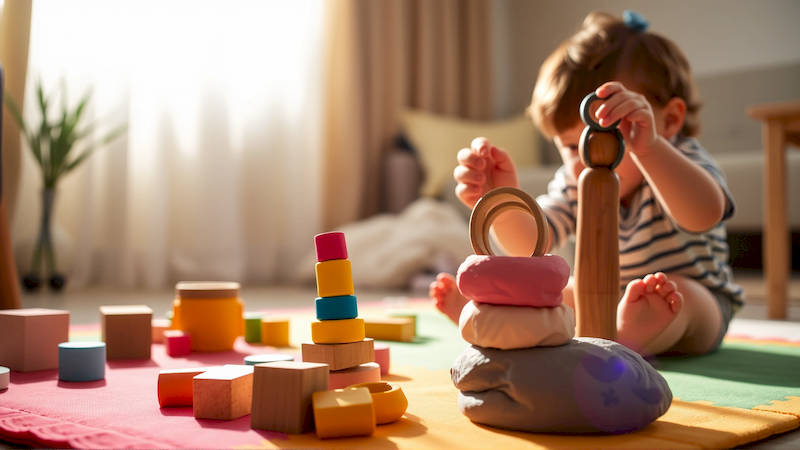
Building with blocks, LEGOs, or even stacking cups are excellent activities for developing hand-eye coordination, as they demand precise hand movements and spatial reasoning. These activities require children to visualize a structure in their mind and then translate that vision into reality using their hands. It’s not just about physical coordination; it's about the brain processing information and sending accurate instructions to the body.
Start with larger blocks and simple creations, such as towers or walls. Encourage your child to describe what they are building and how they are doing it. This verbalization process reinforces their understanding of spatial relationships. As their skills improve, introduce smaller blocks and more complex designs. Challenge them to follow instructions for building specific structures or to copy structures you have already created.
This kind of play also provides a fantastic opportunity to incorporate problem-solving skills. If a tower keeps falling over, encourage your child to think about what might be causing the problem and to try different solutions. The iterative process of building, failing, and adjusting is crucial for developing both hand-eye coordination and resilience. Consider introducing building challenges like "build the tallest tower" or "build a house for your favorite toy," adding an element of fun and motivation.
Arts and Crafts: Precision and Creativity Combined
Activities like drawing, painting, coloring, cutting with scissors (with close supervision!), and threading beads are fantastic for enhancing fine motor skills and hand-eye coordination. These activities benefit from a diversity of textures, materials, and mediums. Each activity presents unique challenges that target different aspects of hand-eye coordination, fostering a well-rounded development. For instance, cutting with scissors requires the child to visually track the line and coordinate the movement of their hand and the scissors.
When introducing these activities, focus on the process rather than the product. Encourage your child to experiment and explore. Don't worry about whether their drawing looks "realistic" or their painting is "messy." The goal is to provide opportunities for practice and build confidence. Providing varied art supplies – crayons, markers, paintbrushes of different sizes, textured paper – expands the range of visual and tactile experiences, leading to even greater developmental benefits.
Consider activities that require more precision, such as drawing within the lines, coloring intricate patterns, or creating mosaic art with small tiles. These challenges help to refine their control and accuracy. “Dot-to-dot” activities also provide excellent practice in coordinating hand movements with visual cues. An expert quote from Dr. Angela J. Brooks, a pediatric occupational therapist, states, “Artistic expression isn’t just about creativity; it’s a powerful tool for building the neural pathways responsible for fine motor control and visual-motor integration.”
Movement & Music: Rhythm and Coordination
Incorporating movement and music into playtime provides a dynamic and engaging way to improve hand-eye coordination. Activities like dancing to music, playing musical instruments (even simple ones like tambourines or shakers), and rhythmic clapping games all require children to coordinate their movements with auditory and visual cues. The combination of physical activity with sensory input stimulates brain development and strengthens neural connections.
Simple games like "Simon Says" or "Follow the Leader" encourage children to imitate movements, requiring them to visually track the leader and coordinate their own body to match. Playing with bubbles is another fun activity that promotes hand-eye coordination. Children need to track the bubbles as they float and move, and then coordinate their arm movements to pop them.
Musical instruments are especially beneficial. Hitting a drum at the correct beat requires precise timing and coordination. Playing a simple keyboard or xylophone encourages children to visually identify notes and then coordinate their fingers to press the corresponding keys. These activities are not only fun but also invaluable for developing a sense of rhythm and timing, which are essential components of both physical and cognitive development.
Everyday Opportunities: Integrating Practice into Daily Routines
Improving hand-eye coordination doesn't require dedicated playtime. Many everyday activities offer opportunities for practice. Encourage your child to help with simple household tasks like setting the table (placing utensils and napkins), sorting laundry (matching socks), or pouring their own drinks (with supervision). These activities require precise movements and visual attention.
Even mealtimes can be opportunities for practice. Encourage your child to use utensils independently as much as possible. This is a great way to develop their fine motor skills and hand-eye coordination. Play games that involve manipulating small objects, such as picking up Cheerios one at a time or building a tower with small snacks.
Furthermore, reading books together can implicitly support hand-eye coordination. Encourage your child to point to pictures, follow the lines of text with their finger, and turn the pages of the book. These seemingly simple actions contribute to the development of visual tracking and hand-eye coordination. The key is to be mindful of these opportunities and to encourage your child to participate actively in daily routines.
Conclusion: Nurturing Growth Through Playful Practice
Developing robust hand-eye coordination in preschoolers is paramount, forming a crucial foundation for future academic, athletic, and social success. Fortunately, fostering this skill doesn't require expensive toys or complicated lessons. Simple, engaging activities incorporated into daily routines can make a significant difference. We’ve explored a variety of exercises, from throwing and catching to building, arts and crafts, and movement-based games, all of which offer unique opportunities for practice and development.
Remember that every child develops at their own pace. The key is to create a supportive and encouraging environment where your child feels comfortable exploring, experimenting, and learning. Focus on the process, celebrate effort, and adapt activities to their individual skill level. If you have concerns about your child’s development, consult with a pediatrician or occupational therapist for personalized guidance and support. Ultimately, by prioritizing playful practice and providing enriching experiences, we can empower our preschoolers with the skills they need to thrive. The consistent application of these strategies, coupled with patient encouragement, will set your child on a path toward confident exploration and a lifetime of learning.
Deja una respuesta