How to Foster Peer Interaction to Enhance Communication Skills
Communication is more than just speaking; it's a complex tapestry woven with social cues, emotional understanding, and the ability to navigate conversations. While parents naturally focus on directly teaching language to their children, a crucial element often overlooked is the power of peer interaction. Children aren’t simply learning what to say, but how to say it, when to say it, and to whom – skills best honed through spontaneous, unstructured play with others their age. This article delves into the vital connection between peer interaction and communication skill development, providing parents with practical strategies for fostering these interactions and maximizing their benefit.
The formative years are a period of rapid neurological development, particularly regarding the brain regions responsible for social cognition. Exposure to diverse communication styles presented by peers challenges children to adapt, negotiate, and clarify their thoughts, leading to enhanced verbal and non-verbal comprehension. Ignoring these opportunities can inadvertently hinder a child's ability to form strong social bonds and effectively communicate throughout their life. Understanding the nuances of peer-driven language acquisition equips parents to actively support this crucial developmental phase.
- Creating Opportunities for Unstructured Play
- Facilitating Communication in Diverse Play Scenarios
- Addressing Communication Challenges During Peer Interactions
- The Importance of Modeling Effective Communication
- Recognizing and Supporting Different Communication Styles
- Expanding the Circle: Group Activities and Organized Play
- The Long-Term Benefits and Continued Support
Creating Opportunities for Unstructured Play
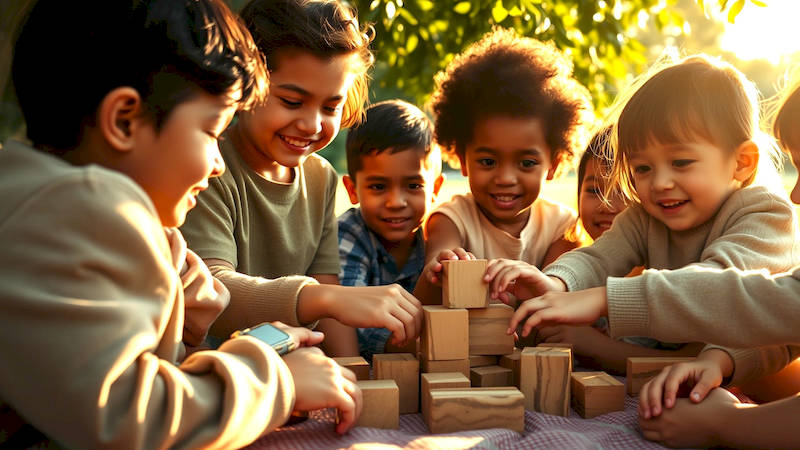
Unstructured play, often defined as child-led activities with minimal adult intervention, is the bedrock of peer interaction and communication growth. This is where children negotiate rules, resolve conflicts, and spontaneously create narratives together. It’s a stark contrast to directed activities where an adult controls the flow and limits the need for genuine two-way communication. Think of building with blocks – directed play might involve following instructions to build a specific castle, while unstructured play lets them decide what to build, how to build it, and who does what.
The key is providing the environment for this play to occur, rather than orchestrating it. This could be regular playdates, access to parks and playgrounds, or even simply allowing time for neighborhood children to gather. Avoid the temptation to constantly intervene to "fix" conflicts or guide the play. Instead, position yourself as a supportive observer, stepping in only when safety is at risk. Remember, even seemingly chaotic play is incredibly valuable in teaching cooperation and compromise, skills directly tied to effective communication.
A study by the National Association for the Education of Young Children (NAEYC) demonstrates that children engaged in prolonged periods of unstructured play exhibit greater levels of social-emotional competence and enhanced problem-solving abilities, both of which are critical for robust communication skills. It's not just about talking more; it's about learning how to interact meaningfully.
Facilitating Communication in Diverse Play Scenarios
Not all play scenarios are created equal when it comes to fostering communication. Imaginative play, for instance – role-playing as doctors, chefs, or superheroes – necessitates verbal negotiation, character development, and collaborative storytelling. Similarly, games with rules, even seemingly simple ones like tag, require children to articulate those rules, request clarifications, and adapt to changing circumstances.
Parents can subtly enhance these scenarios. Encourage open-ended questions during play. Instead of asking, “Did you have fun?” try, “What was the funniest thing that happened during your game?” or “Tell me about the story you and [friend’s name] created.” Also, introduce role-playing prompts like, "Pretend you're a detective and need to ask your friend for clues," or "Imagine you're building a restaurant – what will be on the menu?" These gentle nudges encourage more elaborate and nuanced communication. It’s about extending their natural inclinations, not dominating their play.
A common challenge is dealing with children who are naturally quieter or more reserved. Don’t pressure them to take center stage. Encourage more outgoing peers to draw them into the conversation with inclusive questions like, “What do you think, [child’s name]?” or "What's your favorite part of the game so far?". Focus on celebrating small victories – any attempt to participate, even if it's a simple nod or a one-word answer.
Addressing Communication Challenges During Peer Interactions
Conflicts are inevitable during peer play, but they offer critical learning opportunities. Often, parents' instinct is to intervene and immediately resolve the dispute. However, a more effective approach is to allow children the space to attempt resolution themselves, acting as a facilitator rather than a judge. Guide them through the process by asking prompting questions: “What happened?”, “How did that make you feel?”, and “What could you do to fix the problem?”.
This process teaches children crucial communication skills like active listening, empathy, and compromise. It's also an opportunity to model healthy conflict resolution. Avoid taking sides or assigning blame. Instead, focus on helping the children articulate their feelings and negotiate a solution that works for everyone. It’s important to remember that the process of navigating conflict is often more valuable than the outcome. Learning to disagree respectfully and find common ground is a foundation skill for all future relationships.
Consider a scenario where two children are arguing over a toy. Instead of taking the toy away, ask, "What's the problem?" and "How can you both play with the toy?". Guide them toward solutions like taking turns or using the toy together in a new way. This method helps children develop the ability to verbalize their needs and understand the perspectives of others.
The Importance of Modeling Effective Communication
Children learn by observing those around them, and parents are their primary role models. The way you communicate – your tone of voice, your ability to listen attentively, your methods for resolving conflicts – profoundly impacts your child’s communication development.
Ensure your own interactions with others demonstrate respect, empathy and clarity. Avoid interrupting, criticizing, or using overly complex language. When speaking to your child, make eye contact, listen actively to their responses, and validate their feelings, even if you don’t agree with their perspective. Engage in regular family discussions where everyone has a chance to share their thoughts and opinions, encouraging open and honest dialogue. Modeling effective communication isn't about perfection; it’s about demonstrating a willingness to listen, understand, and respond thoughtfully.
Furthermore, be mindful about how you handle disagreements with your partner or other family members. Children are constantly observing these interactions, and they learn as much from how you manage conflict as they do from explicit instructions on how to communicate.
Recognizing and Supporting Different Communication Styles
Children communicate in varied ways. Some are naturally verbose, expressing their thoughts and feelings with ease, while others are more reserved, preferring to observe and process information before speaking. Understanding these different styles is crucial to fostering effective peer interaction. Avoid labeling children as "shy" or "talkative"; instead, focus on celebrating their unique strengths and supporting their individual needs.
For children who are less inclined to initiate conversations, create opportunities for them to engage in smaller, less intimidating playdates with one or two close friends. Provide them with conversation starters or topics of interest to help alleviate anxiety. For children who tend to dominate conversations, gently encourage them to pause and allow others a chance to speak. This could be as simple as saying, "That's a great idea! What do you think, [friend's name]?"
It is crucial to remember that there isn't a "right" way to communicate. The goal isn't to change a child's inherent personality but to equip them with the skills needed to navigate a variety of social situations and communicate effectively in their own way.
Expanding the Circle: Group Activities and Organized Play
While one-on-one playdates are valuable for building close connections, group activities and organized play can expose children to a wider range of communication styles and challenges. Participating in sports, music lessons, art classes, or scouting programs provides opportunities to collaborate with peers, follow instructions, and negotiate roles within a larger group.
These activities often require more complex communication skills, such as giving and receiving feedback, working towards a common goal, and resolving conflicts in a larger setting. It’s important to choose activities that align with your child’s interests and abilities, ensuring they feel comfortable and engaged. Don’t push them to participate in activities they dislike, as this can create anxiety and hinder their communication development.
Consider enrolling your child in a drama class or a public speaking workshop, which can explicitly teach communication skills in a safe and supportive environment. Such activities help children gain confidence in expressing themselves and interacting with others.
The Long-Term Benefits and Continued Support
Fostering peer interaction to enhance communication skills isn't a one-time effort; it’s an ongoing process that requires consistent support and encouragement. The benefits extend far beyond childhood, shaping a child’s ability to form meaningful relationships, succeed academically, and thrive professionally. Effective communication skills are essential for navigating the complexities of life and achieving personal fulfillment.
As children grow, continue to provide opportunities for social interaction, encourage them to participate in activities that challenge their communication abilities, and model effective communication in your own interactions. Be a patient and supportive listener, and celebrate their progress, no matter how small. Remember, the goal isn’t just to teach them what to say, but to empower them to communicate confidently, authentically, and effectively throughout their lives.
In conclusion, nurturing a child’s communication skills via peer interaction isn't a passive activity; it demands intention, observation, and a willingness to facilitate rather than dictate. By providing opportunities for unstructured play, gently guiding conflict resolution, modeling effective communication, and recognizing individual styles, parents can equip their children with the essential tools for navigating the social world and building lasting relationships. Prioritizing this aspect of child development is an investment that yields immeasurable returns – a confident, well-adjusted individual prepared to connect and communicate effectively throughout their life. The power of playdates, and the intentionality surrounding them, is a cornerstone of healthy social and emotional development.
Deja una respuesta