The Role of Play in Building Language and Social Interaction
Play is often perceived as simply a delightful pastime for children, a way to fill their days with fun and laughter. However, to view play solely as recreation is to profoundly underestimate its fundamental role in a child's development. Play is, in fact, the primary engine of learning, and crucially, a powerhouse for building both language acquisition and social interaction skills. From babbling with toys to negotiating roles in pretend games, children are constantly honing their ability to communicate and connect with the world around them. This article will delve into the remarkable connection between play and development, offering insights and practical strategies for parents and caregivers to leverage the power of play to foster thriving communication and social-emotional growth in children. The early years are particularly crucial, with brain development being most rapid during this time; play provides the rich sensory and interactive experiences needed to sculpt neural pathways associated with language and social understanding.
The importance of early language skill development cannot be overstated. Research indicates a strong correlation between a child’s vocabulary at age three and their literacy skills in later life. Beyond academic success, effective communication is the bedrock of healthy relationships, emotional regulation, and overall well-being. Similarly, social-emotional competence – the ability to understand and manage emotions, empathize with others, and build positive relationships – is paramount to a child's success in school, work, and life. Play provides a natural, low-pressure environment for children to develop these essential skills, setting the stage for a lifetime of positive outcomes.
- The Neuroscience of Play and Language Development
- Types of Play and their Linguistic Benefits
- The Role of Adults in Scaffolding Playful Communication
- Play and the Development of Social Interaction Skills
- Addressing Challenges: Supporting Children with Language Delays through Play
- Creating a Playful Environment: Practical Tips for Parents
The Neuroscience of Play and Language Development
The brain undergoes tremendous development during childhood, particularly in areas responsible for language and social cognition. Play supports this development by stimulating these areas through rich sensory input and social interaction. When a child engages in play, they are actively constructing neural connections, strengthening existing pathways, and creating new ones. This process is significantly enhanced when play involves other children or responsive caregivers. The release of dopamine during playful activities further reinforces learning and motivates the child to continue exploring and experimenting with communication.
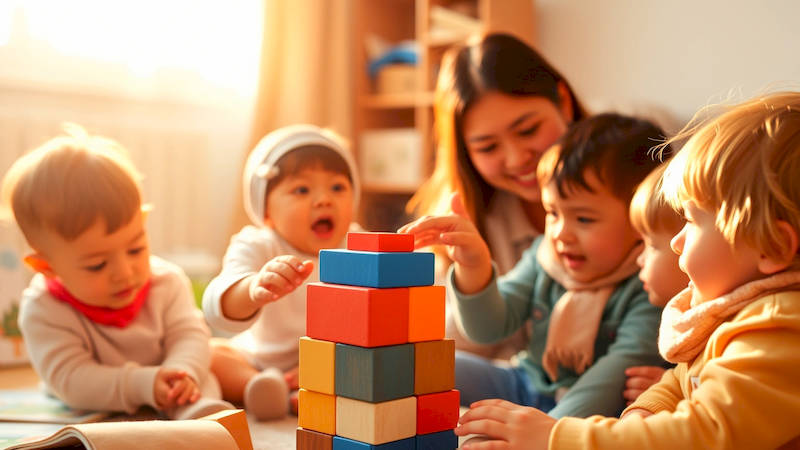
Specifically, play activates the prefrontal cortex, which is responsible for executive functions like planning, problem-solving, and impulse control – all of which are vital for effective communication. For example, a child building a tower with blocks isn’t just developing fine motor skills; they’re also planning the construction, anticipating potential challenges (like the tower falling), and adapting their strategy accordingly. All these mental processes require and strengthen language skills, whether they verbally articulate their plans or internalize them. A study published in Pediatrics demonstrated that children who engage in more complex play have larger vocabularies and demonstrate advanced narrative skills.
Furthermore, the repetition inherent in play – repeatedly saying “vroom” while pushing a car, or narrating the actions of a doll – reinforces language patterns and strengthens memory. This repeated exposure and use of language in meaningful contexts solidifies understanding and facilitates fluency. It's not simply what is said, but how it’s said, and the context in which it’s said, that makes play such an effective language-learning tool.
Types of Play and their Linguistic Benefits
Different types of play offer unique opportunities for language development. Solitary play, while often underestimated, allows children to practice internal speech and narrate their own actions, building foundational language skills. Parallel play, where children play alongside each other without direct interaction, introduces them to the language of observation and description. However, it’s interactive play – such as cooperative play and pretend play – that truly maximizes linguistic gains.
Cooperative play, where children work together to achieve a common goal (building a fort, playing a board game), necessitates negotiation, turn-taking, and clear communication. Children learn to express their ideas, listen to others, and resolve conflicts verbally. Pretend play, however, is arguably the most potent catalyst for language development. When children engage in pretend scenarios (playing house, being doctors, superheroes) they are creating their own worlds and narratives, requiring them to use complex language, imagine different perspectives, and think symbolically. Vygotsky’s sociocultural theory emphasizes the role of social interaction in cognitive development, and pretend play embodies this perfectly, creating a "zone of proximal development" where children explore and practice advanced language skills with support from peers and adults.
For example, a child pretending to be a chef will commonly use imperative statements (“Stir the soup!”), descriptive language (“It smells delicious!”), and create elaborate stories about their culinary creations– naturally expanding their vocabulary and grammatical structures.
The Role of Adults in Scaffolding Playful Communication
While children are naturally inclined to play, adults play a crucial role in maximizing its developmental benefits. This isn’t about directing play, but rather scaffolding it – providing just enough support to help children reach their full potential without taking over. Adults can model language, expand on children’s utterances, and introduce new vocabulary.
Effective scaffolding involves techniques like “expansion,” where an adult repeats and expands on a child’s statement. If a child says, “Car go fast!” an adult might respond, “Yes, the car is going very fast!” This provides a correct grammatical model and introduces the concept of adverbs. Another useful technique is “labeling," where adults name objects and actions during play. For example, “You’re building a tall tower with the red blocks!” This expands the child's vocabulary and helps them connect words to real-world objects. Furthermore, asking open-ended questions ("What happens next?" "How did the bear feel?") encourages children to think critically and express their thoughts and feelings.
It's also important to remember that simply narrating a child’s play (e.g., “You’re pushing the car. Now you’re stopping the car.”) can significantly boost language development. This provides a running commentary that connects actions with language, and models complex sentence structures for the child to absorb.
Play and the Development of Social Interaction Skills
Language and social skills are inextricably linked. The ability to communicate effectively is fundamental to building and maintaining relationships, resolving conflicts, and navigating social situations. Through play, children practice all of these skills in a safe and supportive environment.
Shared play encourages children to learn how to share, take turns, negotiate, and compromise. Pretend play, in particular, allows them to explore different social roles, practice empathy, and develop an understanding of others' perspectives. When children play “doctor,” for example, they learn to role-play both the doctor and the patient, experiencing the situation from different viewpoints. Similarly, playing “house” requires children to negotiate roles, share responsibilities, and resolve conflicts – all essential skills for navigating real-life relationships.
Researchers have found that children with strong social-emotional skills are better able to regulate their emotions, manage stress, and form positive relationships. These skills are also crucial for academic success, as they facilitate collaboration, communication, and problem-solving in the classroom.
Addressing Challenges: Supporting Children with Language Delays through Play
While play is beneficial for all children, it can be particularly powerful for those with language delays or social communication difficulties. By adapting play activities to the child’s developmental level and providing targeted support, parents and caregivers can help these children make significant progress. This might involve simplifying language, using visual aids (picture cards, social stories), and breaking down complex tasks into smaller, more manageable steps.
For example, a child struggling with expressive language might benefit from using puppets to tell stories, as the puppet provides a "safe" medium for communicating. A child with difficulty understanding social cues might benefit from role-playing specific social scenarios with an adult, practicing appropriate responses and strategies. Furthermore, creating a predictable and structured play environment can reduce anxiety and promote engagement. It is vital that if you suspect your child is experiencing a language delay, you seek professional guidance from a speech-language pathologist. They can provide a comprehensive assessment and develop an individualized intervention plan.
Creating a Playful Environment: Practical Tips for Parents
Fostering a playful environment isn't about expensive toys or elaborate setups. It’s about intentionality and creating opportunities for children to engage in spontaneous, imaginative play. Prioritize unstructured play time, minimize screen time, and provide a variety of open-ended materials that can be used in multiple ways – blocks, art supplies, dress-up clothes, and natural materials like sticks and stones.
Make time for joint attention and follow the child’s lead. This means getting down on their level, observing their play, and responding to their cues. Be enthusiastic and supportive, and avoid correcting or criticizing their efforts. Read aloud regularly, engaging in interactive storytelling. Encourage pretend play by asking questions, providing props, and joining in the fun. Finally, remember that you are your child’s most important playmate. Your engagement and enthusiasm will have a profound impact on their language and social-emotional development.
In conclusion, play is not merely a frivolous activity; it's a critical component of child development that profoundly impacts language acquisition and social interaction skills. By understanding the neuroscience of play, recognizing the benefits of different types of play, and actively scaffolding playful communication, parents and caregivers can harness its power to nurture thriving children. Prioritizing unstructured play, creating a supportive environment, and engaging with children on their level are invaluable steps toward fostering a lifetime of effective communication, positive relationships, and overall well-being. Let us remember that within the joyful world of play lies the foundation for a brighter future.
Deja una respuesta