
Fun and Educational Outdoor Math Activities to Reinforce STEM Learning
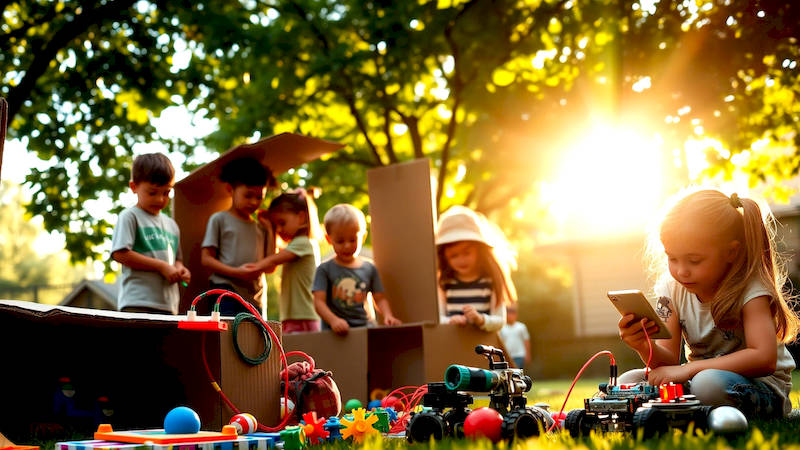
The pursuit of STEM (Science, Technology, Engineering, and Mathematics) education has never been more critical. In a rapidly evolving world driven by innovation, equipping children with a solid foundation in these disciplines is paramount. However, traditional classroom settings don’t always ignite the passion and practical understanding necessary for true STEM competency. A growing body of research indicates that experiential learning—learning by doing—significantly enhances retention and engagement. This is where the great outdoors comes in. Taking math and STEM concepts outside provides a dynamic, engaging, and memorable learning environment, connecting abstract ideas to the tangible world. This article dives into a variety of fun and educational outdoor math activities, designed to reinforce STEM learning, foster critical thinking, and cultivate a genuine love for these essential fields.
Moving beyond worksheets and textbooks, outdoor activities offer a unique opportunity to contextualize mathematical principles. A simple hike can become a geometry lesson, a backyard garden a data collection experiment, and a trip to the park an exercise in measurement and estimation. The key is to shift the focus from rote memorization to exploration and application. Furthermore, outdoor learning encourages collaboration, problem-solving, and resilience—skills that are just as vital as mathematical proficiency. With a little creativity, parents and educators can seamlessly integrate STEM learning into everyday outdoor experiences, making education an adventure rather than a chore.
This article is geared towards parents, educators, and anyone seeking to enrich a child’s STEM education through immersive, outdoor activities. It’s designed to provide a comprehensive toolkit of ideas, geared towards different age groups and skill levels. We will explore activities that range from simple counting exercises for preschoolers to more complex geometric explorations for older children, all while anchoring the learning experience in the natural world. The hope is to empower anyone to transform ordinary outdoor spaces into vibrant, effective STEM learning labs.
- Nature's Number Line: Early Math Skills (Preschool - Kindergarten)
- Geometric Explorations: Shape, Space, and Measurement (Grades 1-3)
- The Backyard Scientist: Data Collection and Graphing (Grades 3-5)
- Outdoor Engineering Challenges: Problem Solving and Design (Grades 4-6)
- Mapping and Navigation: Applying Geometry and Spatial Reasoning (Grades 5-8)
- The Role of Estimation and Proportional Reasoning (All Ages)
- Conclusion: Cultivating a Lifelong Love for STEM
Nature's Number Line: Early Math Skills (Preschool - Kindergarten)
For the youngest learners, the outdoors provides a perfect setting to grasp fundamental number concepts. Activities in this age range should focus on counting, sorting, and basic geometric shapes, all presented through playful exploration. Starting with simple counting games – “Let’s count how many red flowers we see!” – instantly connects numbers to tangible objects. This is a critical stepping stone to understanding quantity and cardinality. Avoid overly structured exercises at this stage; the goal is to introduce the idea of numbers, not to force memorization.
Another fantastic activity is nature-based sorting. Gather leaves, pebbles, sticks, or flowers and ask your child to sort them by color, size, or shape. This teaches categorization skills, a foundational concept in mathematics and data analysis. You can also introduce simple patterns by arranging these natural items – “leaf, pebble, leaf, pebble…” – and encourage the child to continue the sequence. This not only reinforces the concept of patterns but also builds visual discrimination skills.
Expanding on shape recognition, go on a “shape hunt” in the park. “Can you find something that is a circle? What about a square?” This builds spatial reasoning skills, linking geometric shapes to real-world objects. It’s important to emphasize that shapes aren’t always perfect; a leaf may resemble an oval, and that's perfectly acceptable. This instills a sense of flexibility in their thinking and avoids rigid expectations.
Geometric Explorations: Shape, Space, and Measurement (Grades 1-3)
As children progress into early elementary school, outdoor activities can be scaled to introduce more complex geometric concepts. Measuring the perimeter and area of garden beds or play areas using non-standard units (like footsteps or hand spans) is a great way to understand these concepts practically. Have children estimate the perimeter first, then physically measure it, fostering a crucial connection between estimation and precise measurement. The use of non-standard units initially removes the hurdle of understanding metric or imperial systems, allowing them to focus on the underlying concept of measurement.
Building simple structures using sticks and leaves introduces the concept of 3D shapes and spatial reasoning. Encourage children to design and build a small fort, emphasizing the shapes they are using (triangles for stability, rectangles for walls). Ask questions like, “How can you make your structure stronger?” or “What shape would be best for the roof?” This fosters problem-solving skills and encourages them to think like engineers. Critically, embracing failed structures is important - framing it as a learning opportunity rather than a setback.
Exploring symmetry in nature is another engaging activity. Collect leaves and point out the line of symmetry down the middle. Discuss how both sides are mirror images of each other. This exercise also extends to observing insects and flowers, subtly introducing the concept of bilateral symmetry. This not only reinforces geometric understanding but also highlights the beauty and order present in the natural world.
The Backyard Scientist: Data Collection and Graphing (Grades 3-5)
The outdoor environment is a natural laboratory for data collection and analysis, vital skills in STEM. A simple project could involve tracking the growth of plants over several weeks. Have your child measure the plant’s height regularly and record the data in a table. This reinforces both measurement skills and data organization. Then, introduce the concept of graphing by having them represent the plant’s growth visually using a line or bar graph.
Weather observation is another excellent opportunity for data collection. Keep a daily record of temperature, rainfall, wind speed (using a simple homemade anemometer), and cloud cover. This allows children to understand patterns in weather and introduces the concept of averages and trends. Discussing the influence of these factors on local ecosystems adds a scientific dimension to the activity. This long term continuous data collection teaches the importance of persistence and meticulous detail.
Creating a bird feeder and recording the types and numbers of birds that visit provides data for analyzing biodiversity. This introduces basic ecological concepts and the importance of environmental monitoring. Encourage children to research the different bird species and learn about their habitats and behaviors. This blends mathematical data collection with scientific observation and research.
Outdoor Engineering Challenges: Problem Solving and Design (Grades 4-6)
Encourage children to think like engineers by presenting them with outdoor design challenges. For example, task them with building a bridge using only natural materials (sticks, stones, leaves) that can support a certain weight (e.g., a small toy car). This requires them to consider structural integrity, weight distribution, and material strength. The iterative process of designing, building, testing, and refining their bridge is a key component of engineering design. It’s vital to allow for failure and encourage them to analyze why their design failed, and how it can be improved.
Another challenge could involve designing a simple water filtration system using materials found in nature (sand, gravel, charcoal). This teaches them about the principles of filtration and water purification. After building the system, test its effectiveness by filtering dirty water and observing the results. This provides a practical understanding of how these systems work, moving beyond abstract scientific concepts.
Designing a miniature golf course using natural obstacles and creating scorecards requiring calculated distances and angles reinforces geometric principles and spatial reasoning in a fun and engaging way. This bridges the gap between mathematical concepts and real-world application, showcasing the practical usefulness of STEM skills.
Mapping and Navigation: Applying Geometry and Spatial Reasoning (Grades 5-8)
For older children, incorporating mapping and navigation activities can effectively reinforce geometric concepts and spatial reasoning skills. Using a compass and map, have them create a treasure hunt for younger siblings or friends. This requires them to understand direction, scale, and distance, all essential elements of geography and cartography. It also involves planning and problem-solving skills, as they must design a route that is challenging but achievable.
Creating a topographic map of a local park or hiking trail introduces the concept of contour lines and elevation. While creating this map doesn’t require advanced surveying equipment, it encourages observation of changes in terrain and an understanding of how these changes are represented graphically. This type of activity can be scaled down and simplified for younger students using models like playdough hills.
Using GPS coordinates to locate specific points of interest (trees, rocks, landmarks) reinforces coordinate geometry and the application of latitude and longitude. This can be done using a smartphone or dedicated GPS device. Combining this with creating a scavenger hunt adds an element of excitement and encourages teamwork.
The Role of Estimation and Proportional Reasoning (All Ages)
Throughout all of these activities, emphasizing estimation is crucial. Before measuring anything, ask your child to estimate the length, weight, volume, or number of items. This develops a sense of number and scale, and reinforces the concept that numbers aren’t just abstract symbols but represent real-world quantities. Compare their estimates to the actual measurements to discuss the reasons for any discrepancies.
Proportional reasoning – understanding the relationships between quantities – can be introduced even with younger children. For example, if you're making a scaled-down model of a tree using twigs, ask, “If the real tree is 10 feet tall, and we want our model to be 1 foot tall, what scale are we using?” This connects mathematical concepts to real-world proportions.
Embrace the beauty of imperfection. Outdoor measurements are rarely precise due to uneven terrain and the variability of natural objects. This presents an opportunity to discuss the importance of approximations and the concept of error.
Conclusion: Cultivating a Lifelong Love for STEM
Outdoor math activities offer a powerful and engaging way to reinforce STEM learning, moving beyond rote memorization and fostering a deeper understanding of core concepts. By connecting abstract ideas to the tangible world, these activities ignite curiosity, encourage exploration, and cultivate a lifelong love for science, technology, engineering, and mathematics.
The key takeaways are simple: prioritize hands-on learning, embrace the natural environment as a laboratory, and focus on the process of discovery rather than solely on finding the "right" answer. Encourage estimation, ask open-ended questions, and celebrate both successes and failures as learning opportunities. Start small, adapt activities to your child’s age and interests, and most importantly, have fun. By transforming outdoor spaces into STEM learning labs, we can empower the next generation of innovators and problem-solvers. As educator and researcher Dr. Emily Carter states, “The most effective STEM education isn't about delivering information, it's about cultivating a mindset of curiosity and exploration.” Let’s take the classroom outdoors and unlock the STEM potential within every child.
Deja una respuesta