Tips for Integrating STEM Learning into Daily Routines Without Extra Screen Time
In today’s rapidly evolving world, proficiency in Science, Technology, Engineering, and Mathematics (STEM) is no longer just a pathway to specific careers—it’s a fundamental skill set for navigating modern life. While many parents recognize the importance of STEM education, a common concern revolves around the reliance on screens to deliver it. Excessive screen time poses risks to children's development, including potential impacts on attention spans, sleep patterns, and physical health. Fortunately, building a strong STEM foundation doesn’t require apps, tablets, or coding websites. In fact, some of the most effective STEM learning happens organically, woven into the fabric of everyday experiences.
This article will explore practical, screen-free strategies for nurturing your child’s STEM abilities through play, observation, and engagement with the world around them. We'll delve into how to transform ordinary moments—from cooking dinner to going for a walk—into opportunities for exploration, problem-solving, and critical thinking. Our aim is to empower you with the knowledge and tools to foster a lifelong love of learning in STEM, without sacrificing valuable time or exposing your child to the downsides of excessive screen use.
- Leveraging the Power of Play: Building Foundational STEM Skills
- The Kitchen as a STEM Laboratory: Cooking & Baking Adventures
- Nature Walks & Outdoor Exploration: Observing the Natural World
- Storytelling & STEM: Narrative as a Launchpad for Inquiry
- Asking “Why?” & Encouraging Curiosity: Cultivating the Scientific Mindset
- Conclusion: Embedding STEM into the Everyday
Leveraging the Power of Play: Building Foundational STEM Skills
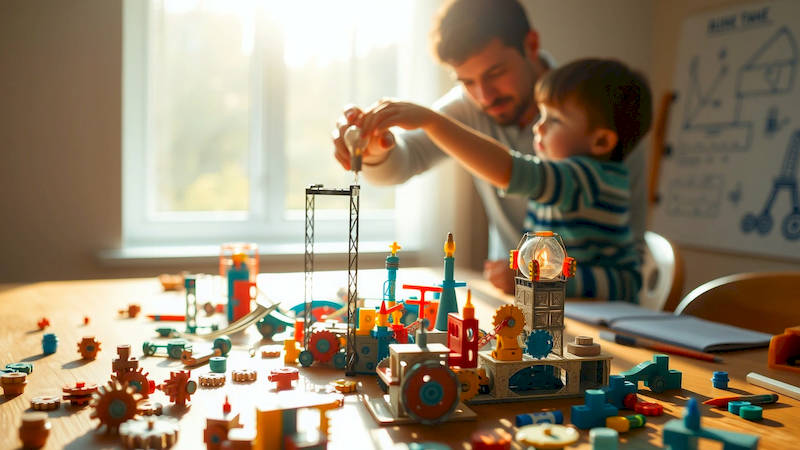
Play is often considered merely recreational, but it's a crucial catalyst for cognitive development and, critically, a fertile ground for STEM learning. Unstructured play, in particular, allows children to explore concepts through experimentation and discovery. Think beyond commercially produced “STEM toys” (though those can be valuable too) and consider the potential of everyday objects. Building with blocks isn’t just about creating towers, it’s about understanding structural integrity, balance, and spatial reasoning – core engineering principles. Similarly, playing with water and sand introduces early concepts in physics, like volume, density, and fluid dynamics.
Encourage open-ended play scenarios where children can build, create, and problem-solve with minimal direction. Instead of asking “Build me a tower,” try “What can you build with these blocks?” This encourages creativity and allows the child to drive the learning process. Consider providing a “tinker tray” filled with loose parts like bottle caps, buttons, pipe cleaners, and cardboard tubes. These materials inspire imaginative construction and promote problem-solving skills. A 2018 study by the LEGO Foundation highlighted that children learn best through playful experiences that are self-directed and intrinsically motivated.
Furthermore, incorporate games that naturally involve STEM concepts. Board games that require strategic thinking, like chess or checkers, foster logical reasoning. Simple card games can reinforce math skills like counting and pattern recognition. Puzzles, from jigsaw puzzles to logic puzzles, enhance spatial awareness and problem-solving abilities. Play is not the opposite of work; it's often the most effective form of learning, particularly when it comes to establishing a strong foundation in STEM.
The Kitchen as a STEM Laboratory: Cooking & Baking Adventures
The kitchen is a surprisingly rich environment for STEM exploration. Cooking and baking are essentially applied chemistry and math. Measuring ingredients teaches fractions, ratios, and proportional reasoning. Observing how ingredients change when mixed or heated demonstrates chemical reactions. Even something as simple as following a recipe introduces the concept of algorithms—step-by-step instructions to achieve a desired outcome.
Involve your child in age-appropriate kitchen tasks, explaining the science behind what’s happening. When baking cookies, discuss how the baking powder creates air bubbles, making the cookies light and fluffy. When making soup, explain how the heat causes the vegetables to soften and release their flavors. Challenge your child to double or halve a recipe, requiring them to apply their math skills. "If we want to make half the recipe, how much flour do we need?" This isn't just about following instructions, it’s about understanding why the instructions work.
Beyond the recipe itself, explore the science of food preservation. Discuss why we refrigerate food or how pickling works. Comparing different types of flour and their impact on the final product can introduce concepts of molecular structure. Cooking and baking provide tactile and sensory experiences that make learning memorable and engaging, demonstrating that science isn't confined to a laboratory.
Nature Walks & Outdoor Exploration: Observing the Natural World
The natural world is an open-air classroom brimming with STEM opportunities. A simple nature walk can become a lesson in biology, ecology, and geology. Encourage your child to observe the plants, animals, and landforms around them. Ask questions like, “Why do you think that tree is so tall?” or “What do you see insects doing?” Observe the patterns in leaves, the shapes of rocks, and the life cycle of plants. Collect leaves, rocks, and other natural objects for closer examination.
Bring along a magnifying glass to encourage detailed observation. Discuss the different habitats of the plants and animals you encounter. Building a bird feeder can teach engineering principles, forcing children to consider factors like stability, accessibility, and material selection. Creating a simple compost bin introduces concepts of decomposition and the nutrient cycle. “Where does all the food waste go, and what happens to it?” are good starting points for discussion.
Furthermore, outdoor exploration encourages problem-solving. Building a fort requires spatial reasoning and engineering skills. Navigating a trail teaches map-reading skills and spatial awareness. Observing weather patterns introduces basic meteorology. The outdoors provides a rich, dynamic environment for hands-on learning that stimulates curiosity and a lifelong appreciation for the natural world. As environmental educator Richard Louv argues in his book Last Child in the Woods, connecting children with nature is vital for their cognitive, emotional, and physical wellbeing.
Storytelling & STEM: Narrative as a Launchpad for Inquiry
Storytelling isn’t just about entertainment; it can be a powerful tool for introducing STEM concepts. Choose books that feature characters tackling scientific problems or exploring technological innovations. Discuss the challenges the characters face, how they approach problem-solving, and the scientific principles at play. Even fictional stories can spark curiosity and conversations about real-world STEM concepts.
Encourage your child to create their own STEM-themed stories. Ask them, "What if you could invent a machine to...?". This fosters creativity and imagination while encouraging them to think about the practical applications of STEM concepts. Challenge them to design a story about a robot that helps solve a real-world problem, or a scientist who makes an important discovery. Their stories don't need to be scientifically accurate; the process of thinking through the challenges and solutions is the key.
Extend storytelling beyond books by incorporating STEM-related activities. After reading a story about space exploration, build a cardboard rocket ship. If the story involves building something, try replicating it with building blocks or other materials. Storytelling provides a context for STEM learning, making it more engaging and relatable for children.
Asking “Why?” & Encouraging Curiosity: Cultivating the Scientific Mindset
Perhaps the single most important thing you can do to foster a love of STEM is to encourage your child’s natural curiosity. Respond to their endless stream of “Why?” questions with patience and enthusiasm. Resist the urge to simply provide answers; instead, guide them towards discovering the answers themselves. Ask prompting questions like, “What do you think?” or “How could we find out?”.
Create a “Wonder Wall” – a designated space where your child can post their questions and ideas. This visual representation of their curiosity encourages further inquiry. Model a scientific mindset yourself by asking questions aloud and demonstrating a willingness to learn. If you don't know the answer to a question, admit it and suggest researching it together.
Avoid discouraging experimentation, even if it leads to messiness or failure. Failure is an essential part of the learning process. Frame mistakes as learning opportunities. "That didn't work, but what did we learn from it?". Celebrate effort and perseverance, not just correct answers. According to Carol Dweck's research on growth mindset, praising effort encourages a belief in the power of learning and resilience, crucial attributes for success in STEM.
Conclusion: Embedding STEM into the Everyday
Integrating STEM learning into daily routines doesn’t require a dramatic overhaul of your lifestyle. It’s about shifting your perspective, recognizing the STEM potential in everyday activities, and actively nurturing your child’s natural curiosity. By leveraging the power of play, exploring the science in the kitchen, embracing the outdoors, utilizing storytelling, and fostering a spirit of inquiry, you can create a rich learning environment that lays a strong foundation for future STEM success – and all without relying on excessive screen time.
The key takeaways are simple: focus on hands-on exploration, encourage questioning, and model a love of learning. Start small, be patient, and remember that the goal isn't to turn your child into a scientist, but to equip them with the critical thinking skills and problem-solving abilities they need to thrive in a complex world. Take one or two of the ideas presented here and implement them this week. The journey to fostering a lifelong love of STEM starts with a single curious question.
Deja una respuesta