
Building Basic Robotics Projects with Common Household Items
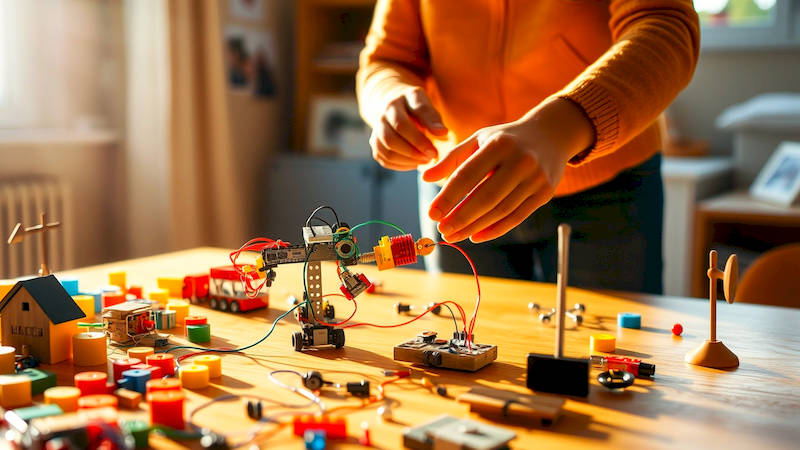
The modern world is undeniably shaped by technology, and robotics is at its cutting edge. Introducing children to the fundamentals of robotics isn’t about grooming them to be future engineers (though it certainly can be!), it’s about fostering critical thinking, problem-solving skills, and a deep understanding of how things work. It builds perseverance, encourages creativity, and unlocks a whole new level of engagement with STEM (Science, Technology, Engineering, and Mathematics) subjects. Often, parents assume robotics requires expensive kits and complex programming. However, the core principles can be beautifully illustrated – and learned – using everyday items found around the house.
This approach dramatically lowers the barrier to entry, making robotics accessible to all children, regardless of socioeconomic background, and sparking an early interest that can have lifelong benefits. Consider this: a 2021 study by the National Math and Science Initiative showed a 15% increase in STEM course enrollment among students who participated in hands-on robotics activities. The inherent fun factor of building and creating something that moves is a powerful motivator, far surpassing traditional classroom lessons. Getting your child involved in these projects is more about the process of discovery than achieving a perfect, polished product.
The beauty of this “household robotics” approach is its adaptability. Projects can be scaled to suit the child’s age and abilities, starting with simple motorized structures and progressing to more complex designs incorporating sensors and basic programming. This article will take you through several engaging projects, providing detailed instructions and highlighting the educational benefits of each. We will emphasize hands-on learning, resourcefulness, and the joy of building something from scratch.
- The Foundation: Understanding Simple Machines and Circuits
- Project 1: The Brushbot – A Vibrating Introduction
- Project 2: The Cardboard Box Robot – Structure and Movement
- Project 3: The Obstacle Avoiding Robot – Introducing Sensors
- Project 4: The Art Bot – Creative Expression Through Robotics
- Extending the Learning: Resources and Next Steps
- Conclusion: Fostering Future Innovators
The Foundation: Understanding Simple Machines and Circuits
Before diving into specific projects, it’s crucial to grasp the foundational principles. Robotics, at its core, utilizes simple machines - levers, pulleys, wheels and axles, inclined planes, screws, and wedges – to amplify force and achieve movement. Understanding how these machines work is the first step. Think of a simple lever: a ruler balanced on a fulcrum (like a pencil) can lift a heavier object with less effort. This concept translates directly into robotic arms or gripping mechanisms. Don't underestimate the power of deconstructing existing toys to help a child visualize these principles.
Equally important is understanding basic circuits. A circuit is a closed loop that allows electricity to flow, powering the motor that drives the robot. You can start by explaining the required components – a power source (batteries), a conductor (wires), and a load (the motor). A flashlight is an excellent example of a simple circuit – the battery provides the power, the wires connect the battery to the bulb, and the bulb is the load. Experimenting with different types of batteries (AA, AAA, 9V) and observing the impact on the motor’s speed can provide valuable lessons. Safety is paramount, so always supervise children when working with electricity.
Introduce the concepts of series and parallel circuits. A series circuit has components connected end-to-end, while a parallel circuit has components connected alongside each other. Explain how adding more components in a series circuit reduces the current to each component, while a parallel circuit maintains the same voltage across all components.
Project 1: The Brushbot – A Vibrating Introduction
The Brushbot is an incredibly simple, yet effective, introduction to robotics. It requires minimal materials: a toothbrush head, a small vibrating motor (often scavenged from old cell phones or available cheaply online), a CR2032 button cell battery, and some double-sided tape. The principle is straightforward: the off-center rotation of the motor’s weight creates vibrations that propel the toothbrush head forward.
To build it, simply attach the motor to the toothbrush head using the double-sided tape and then attach the battery to the motor’s terminals. You'll likely need to experiment with the motor's positioning to find the optimal balance for movement. This project teaches basic circuit construction, vibration as a means of locomotion, and the importance of weight distribution. It's also a great way to introduce the concept of "debugging" – figuring out why something isn't working (e.g. battery polarity, loose connections). Consider challenging your child to modify the Brushbot – can they change the angle of the toothbrush bristles to alter its direction? Can they add small weights to affect its speed or stability?
Project 2: The Cardboard Box Robot – Structure and Movement
Moving beyond simple vibration, let's build a small robot chassis out of cardboard. Materials needed include a cardboard box, cardboard tubes (toilet paper or paper towel rolls), straws, skewers, a DC motor, a battery pack, wires, and tape. This project focuses on building a structural frame and integrating a motor for movement. The basic idea is to attach the motor to the cardboard chassis, using the skewers and straws as axles for wheels made from cardboard circles.
Start by designing and cutting out the cardboard chassis. Then, construct the axles by inserting skewers through straws, and attach cardboard circles to the ends of the skewers to create the wheels. Attach the motor to the chassis and connect it to the axles. Connecting the motor to a battery pack using wires will bring your cardboard robot to life. This project teaches fundamental engineering concepts like structural integrity, axle design, and the relationship between motor speed and wheel rotation. Encourage your child to experiment with different wheel sizes and chassis designs to see how they affect the robot’s performance.
Project 3: The Obstacle Avoiding Robot – Introducing Sensors
This project elevates the complexity by introducing the concept of sensors. You'll need a small chassis (cardboard works well), two DC motors, a battery pack, wires, a ultrasonic distance sensor (HC-SR04 is a common and affordable option), and a microcontroller like an Arduino Nano (or similar). While this requires more advanced components, the principles are accessible.
The ultrasonic sensor emits sound waves and measures the time it takes for them to return, allowing the robot to detect obstacles in its path. The Arduino microcontroller processes this data and controls the motors to steer the robot around the obstacles. Though the programming aspect might require some parental guidance, there are numerous online tutorials and simplified coding environments for beginners. This project beautifully illustrates how robots can "sense" their environment and react accordingly, opening the door to discussions about artificial intelligence and autonomous systems.
Project 4: The Art Bot – Creative Expression Through Robotics
Robotics doesn’t have to be solely about functionality; it can also be a medium for artistic expression. An Art Bot uses a vibrating motor and markers to create unique drawings. Materials needed include a small container (like a yogurt cup), a vibrating motor, a battery, markers, and glue.
Attach the vibrating motor to the container using glue, ensuring that the motor’s shaft is free to vibrate. Attach the markers around the base of the container, ensuring they touch the paper surface. When the motor is activated, the vibrations will cause the Art Bot to move randomly, leaving a trail of color on the paper. This project emphasizes the creative applications of robotics and promotes experimentation with different marker colors, container shapes, and vibration patterns. It’s a fantastic way to show children that engineering and art are not mutually exclusive disciplines.
Extending the Learning: Resources and Next Steps
The projects outlined above are merely starting points. Numerous online resources can provide inspiration and guidance. Websites like Instructables, Make: Magazine, and GitHub offer a wealth of DIY robotics projects suitable for children of all ages. "Science Buddies" is an excellent resource for finding science fair project ideas, many of which can be adapted for robotics. Consider joining a local robotics club or attending STEM workshops to further enhance your child’s learning experience.
Furthermore, don’t be afraid to encourage open-ended exploration. Let your child take the lead in designing and building their own robots, even if they don't follow a specific plan. The process of experimentation, failure, and iteration is just as valuable as achieving a working prototype. Remember, the goal isn’t to create perfect robots, it’s to cultivate a lifelong love of learning and a passion for STEM.
Conclusion: Fostering Future Innovators
Building basic robotics projects with common household items isn’t just a fun weekend activity; it’s an investment in your child’s future. It fosters crucial 21st-century skills such as critical thinking, problem-solving, creativity, and collaboration. By breaking down complex concepts into manageable steps and utilizing readily available materials, we can empower children to become active creators of technology, rather than passive consumers. These projects are designed to be accessible, affordable, and, most importantly, engaging.
The key takeaway is that robotics is not confined to expensive kits and specialized laboratories. With a little imagination and resourcefulness, you can transform everyday objects into learning tools and inspire the next generation of innovators. Start simple, encourage experimentation, and embrace the learning process. The journey from a junk drawer to a junior engineer is full of exciting discoveries and endless possibilities. So, gather your materials, roll up your sleeves, and prepare to build a brighter future, one robot at a time.
Deja una respuesta